Google reviews are the first thing most diners check before deciding where to eat. They see your rating before they visit your website, before they read your menu, and well before they walk through your door. This guide gives you concrete steps to earn more authentic reviews from real guests.
Why Google reviews matter more than most owners realise
When someone searches "restaurant near me Saturday evening", Google returns a map with ratings and review counts. A restaurant with many reviews and an average above 4.5 stars gets far more clicks than the place next door with fewer reviews and a lower score, even if the food is equally good.
That is not unfair. A guest who does not know you has nothing else to go on. Reviews are the closest thing to a friend's recommendation. Picture a couple deciding where to take friends for dinner: they find you on Google Maps, see 28 reviews averaging 4.1, and scroll straight to the place with 94 reviews at 4.6. That decision happens in three seconds and cannot be reversed.
The implication is clear: reviews are visible, trusted, and permanent. They work for you when you are not working, including on evenings you are too busy to think about marketing.
The right moment to ask
Timing matters more than almost anything else. The best moment to ask a guest for a review is immediately after a good experience, while the mood is high and the visit is fresh in their mind. A follow-up email three days later rarely works; asking mid-service when the kitchen is slammed never does.
The natural opening is payment. The meal is done, the guest is happy, and the phone is probably already out for card payment. That is a thirty-to-fifty-second window and a real opportunity.
Picture a server placing the bill and saying: "Glad you enjoyed the evening. If you'd like to leave a Google review, there's a QR code here that goes straight to our page. Takes under a minute." Natural, not pushy, and it gives the guest a clear and easy next step.
Give your team one sentence
Most restaurant owners tell staff to mention reviews "whenever it feels right." It rarely feels right, because it requires an active decision in the middle of a busy service where a dozen other things compete for attention.
The fix is simple: give the team one specific sentence and one specific moment. The moment is payment. A line that works: "If you had a good time tonight, a Google review would mean a lot to us." Twelve words, no sales technique required. Staff are not trying to persuade anyone; they are opening a door for guests who are already satisfied and simply have not thought to say so publicly.
Make sure the QR code at the till links directly to your Google review input page, not to your Google Maps homepage. Every extra tap increases the chance a guest gives up halfway. Google Business Profile lets you generate a direct review link you can encode into a QR code and place wherever it is most visible.
From regular to reviewer
A guest who has visited you five times is far more likely to write a review than a first-timer. They have more to say, a genuine connection to the place, and a stake in your success.
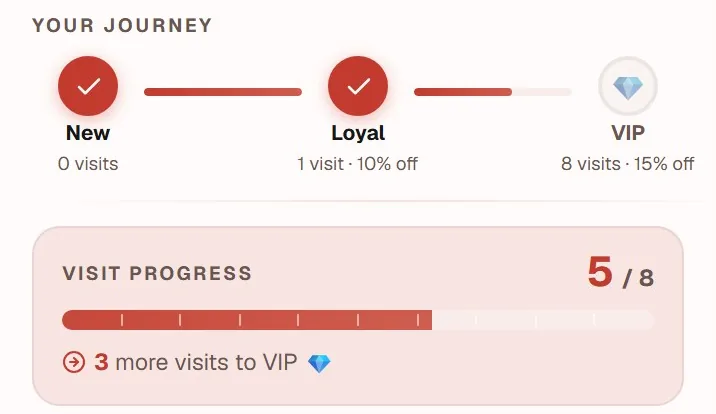
This is where a digital stamp card app pays off beyond the stamps themselves. Each recorded visit strengthens a guest's attachment to your restaurant. Imagine a guest who has collected ten stamps and just redeemed a free starter: that moment leaves a real, positive memory. The next time you ask for a review, they have a story to tell and a reason to help you.
See Loyalty program for restaurants: the complete starter guide for a full walkthrough of building a regular customer base from scratch. For specific tactics to bring guests back more often, read Get more regulars: 7 tactics that work.
Reply to every review
Most restaurant owners respond to negative reviews and ignore positive ones. That is the wrong priority.
Replying to a positive review signals that you notice your guests and that you are present on your own profile. A short, personal response is all it takes: "Thank you for the kind words about the lamb. Hope to see you again soon." Thirty seconds, and it shows every future reader that a real person runs this restaurant.
For negative reviews, the rule is to respond calmly, never defensively, and always with an invitation to resolve things directly. A response that works: "We're sorry the experience didn't live up to expectations. Please reach out to us directly so we can make it right." That is what prospective guests read and use to judge you.
Google also treats regular activity on your profile as a positive signal in local search rankings. A restaurant owner who responds consistently tends to rank better than one who leaves the profile untouched.
Keep your Google profile current
Reviews are one part of your Google profile but not the only part that counts. These basics should always be accurate:
- Opening hours, including changes on public holidays and during seasonal closures
- Address and phone number with no errors
- Four to six food photos in natural light showing actual dishes
- Precise categories: "Restaurant" alone is not enough; add subcategories such as "Nepalese restaurant" or "Family restaurant"
An active and complete profile ranks better in local searches and gives new guests the information they need before they decide; our guide to local SEO for restaurants covers the rest of what lifts you up the Google Maps results. Think of it as your digital front window: it should always look its best.
To tie your Google presence into a broader marketing approach, see our guide on restaurant marketing that works in 2026.
Frequently asked questions
Is it allowed to ask guests for a Google review?
Yes. Asking guests to leave an honest review is perfectly legitimate. What is not allowed is offering a discount or other incentive in exchange for a positive review. A natural, verbal request at the table or the till is not a problem and is the most effective method available to most restaurant owners.
What should I do about a fake or unfair negative review?
Sign in to Google Business Profile and use "Report review" for reviews that violate Google's policies: spam, fabricated content, or reviews from people who have never visited. Google does not remove every review you flag, and the process takes time. Responding professionally to an unfair review often does more for your reputation than waiting for Google to act.
Does a higher review count actually improve my visibility in Google Maps?
Yes. Number of reviews, average rating, and regular profile activity are all factors Google uses when deciding which restaurants appear at the top of local searches. A restaurant with many reviews and a high average generally outranks one with few, all else being equal. It is a long-term investment, but a realistic one: a consistent ask at the till, combined with genuinely good food and hospitality, builds a profile that brings you guests without paid advertising.