Rewards for loyal customers are at the heart of any loyalty program: the tangible thank-you that gives guests a reason to return, time and time again. But which type of reward works best, and when should you choose a free product over an experience or an exclusive perk? This guide gives you a practical overview with examples you can use directly in your business.
Free product: the clearest thank-you
The most common reward is simple: the guest collects a set number of stamps and receives a product for free. The café gives away the eleventh coffee; the bakery gives the tenth loaf; the restaurant offers a free starter or dessert.
The advantage is clarity. The guest understands the reward in an instant, and you can describe it in three seconds at the counter. A free product does not undermine your pricing the way a percentage discount does. It feels like a gift, not a negotiation.
Imagine a café with a ten-stamp card and a free coffee as the reward. The guest has paid for nine coffees and the tenth is free. That works out to roughly ten percent off across the period, but it does not feel like a discount to the guest. It feels like something earned.
Be specific about what the reward is. "A drink of your choice" is better than "a surprise"; "a croissant of your choice" is better than "something from the bakery". The clearer the reward, the stronger the motivation on the way there.
Discount on the next visit: simple, but with one important catch
A percentage or fixed amount off the next visit is easy to set up. Many owners choose it because it feels flexible.
The downside is psychological: a discount tells the guest that your prices are negotiable. The guest starts thinking of the "real" price as something lower than what you print on the menu, and that perception is hard to walk back.
That is not an argument against discounts, but an argument for using them thoughtfully. A time-limited discount works well as a reward when it creates a clear incentive to return within a specific window. "Twenty percent off your next visit in the next 14 days" is stronger than an open offer with no expiry.
Experience rewards: more than a product
An experience as a reward works best when it creates a sense of exclusivity the guest cannot simply buy. Restaurants and cafés with a strong concept are well positioned for this type of reward.
Examples that work in practice:
- An invitation to a tasting evening for regulars, before it opens to the general public
- A table always held for loyalty members during the busiest hours
- A personal introduction to a new seasonal menu from the head chef
Imagine a restaurant with 60 loyal members that each quarter invites the ten guests with the most stamps to an exclusive tasting dinner. None of the ten pay for the evening, but it costs the restaurant one extra preparation and a couple of hours. In return, the evening generates conversation, reviews, and a loyalty that a free dessert rarely matches.
Experience rewards require more planning, but they build a connection between guest and venue that is hard to copy.
Exclusivity and access: you are special
An exclusivity reward sends the guest a signal: she is not just any customer. This can be something very simple, such as a digital "regular member" badge, a personal greeting from the team, or access to a perk not available to everyone.
Examples:
- Early access to weekend reservations before they open to other guests
- A digital regular card with a small welcome perk on sign-up
- Priority on the waiting list when the restaurant is fully booked
These rewards cost almost nothing to deliver, but they work because they appeal to the guest's desire to belong. Belonging is a powerful motive: people return to places where they feel remembered and appreciated.
Gamification: bonus stamps and the spin wheel
A stamp card does not always have to follow the same linear path. Bonus mechanics can re-engage guests who are starting to lose momentum.
Double stamps during a quiet period: Offer two stamps instead of one on Tuesdays and Wednesdays, weekday lunches, or other slow times. It shifts guests to periods you would otherwise struggle to fill, and gives them an extra reason to choose your venue that day over a competitor.
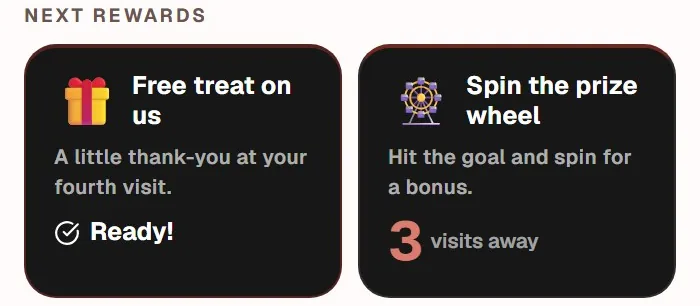
The spin wheel: Some digital loyalty programs offer a spin wheel the guest can use when redeeming a reward. Instead of always receiving the same reward, the wheel spins and the guest might land on a free drink, a dessert, a bonus stamp, or something else entirely. The element of surprise is motivating in itself and gives guests something to talk about.
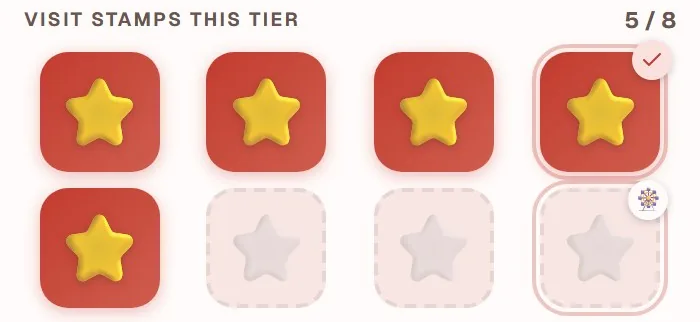
Milestone bonus: The guest receives an extra reward when they hit certain milestones: the fifth visit, the fifteenth visit, the anniversary of signing up. It breaks the monotony of a linear program and gives the guest a reason to keep an eye on their progress.
Which reward suits which type of business?
There is no single right reward for everyone. Here is a rule of thumb:
Café: A free product is the natural choice. Guests visit frequently, and a free product motivates better than an experience that requires planning. Eight to twelve stamps for a free coffee, tea, or smoothie is a solid balance.
Restaurant: A free starter or dessert works better than a discount on the bill, because it feels like an addition to the meal rather than a price reduction. You might also consider a reward that specifically encourages guests to try a new dish.
Bakery: A free product is again the most natural fit. Vary the options between a free morning roll, a slice of cake, or a sandwich, so the reward still feels like a small surprise rather than something routine.
Salon or clinic: A discount on the next treatment or a free sample product (a travel-size shampoo, a mini product) works well, because visits are less frequent and higher value. Exclusivity rewards such as early booking access are particularly effective here.
For a detailed look at how to set stamp targets and reward values in the right proportions, our guide to choosing the right stamp card reward walks through a complete method.
Five signs your current reward is not working
It can happen that a reward you chose at launch no longer keeps guests engaged over time. Here are five signals to watch for:
- Low redemption rate: Guests collect stamps but rarely redeem. The reward may not be attractive enough, or the stamp target may feel too distant.
- High early drop-off rate: Many guests stop at two or three stamps. The start of the program may be missing an early incentive.
- Sign-ups drop after launch: Guests heard about the reward and chose not to join. The reward does not appeal enough to your guest mix.
- Inactive guests close to the reward: Guests with seven of ten stamps who have not been in for months. The goal feels far and the reward is not pulling hard enough. Our guide on winning back lapsed customers covers a plan for exactly this situation.
- Staff do not know what the reward is: If the team has to think about it, guests cannot get a clear answer at the counter. That is a sign the reward is too complicated.
If you want to measure whether your loyalty program is generating a real business return, our article on loyalty program ROI gives you a step-by-step method.
If you are unsure whether a stamp card is the right format for your business in the first place, or whether a membership club would serve your guests better, our guide to membership rewards programmes: which format fits? walks through the decision.
To see what a digital stamp card includes and how to get started, visit the stamp card app page.
Frequently asked questions
How valuable does a reward need to be to motivate guests?
There is no universal answer, but a practical rule of thumb is that the nominal value of the reward should be roughly ten to fifteen percent of the total amount the guest spends to reach it. Set it lower and the motivation is too weak; set it too high and your margin takes a hit. The best calibration comes from testing with your specific guest type and adjusting after the first three to six months of data.
Can I change the reward after guests have already signed up?
Yes, but communicate the change clearly and with enough notice. Guests who are already midway through a stamp cycle can react poorly if the reward suddenly changes. The safest approach is to keep the existing reward for guests already in progress and introduce the new reward for new sign-ups. Alternatively, frame the change as an improved version rather than a reduction.
Should I use the same reward year-round, or are seasonal rewards better?
Both work, but the combination is strongest. A fixed reward gives guests a clear goal to aim for. Seasonal rewards, such as a free hot chocolate in winter or a bonus stamp in July, add variety and give the team something new to mention at the counter. The seasonal reward does not need to replace the fixed reward; it can sit alongside it as a bonus incentive on top of the existing program.