Takeaway venues have a clear advantage: customers come back faster than they would to a sit-down restaurant. But without a server who remembers a regular's usual order, and without an atmosphere that keeps people lingering, the relationship is thinner and easier to break. A digital stamp card for your takeaway gives customers a concrete reason to choose you again the next time they are on their way home with dinner.
The loyalty challenge that is unique to takeaway
A takeaway restaurant lacks the retention mechanisms that come free with a sit-down venue. There is no server who remembers a regular's name, no atmosphere that invites people to stay an extra half hour, and no natural conversation that builds a relationship over time.
That is not necessarily a weakness. Takeaway customers are habit-driven: they order the same thing from the same place because it is convenient, reliable, and good. The challenge is that the habit is fragile. The first time an alternative is faster, cheaper, or easier to find, a customer can switch without a second thought. A loyalty program is your mechanism for making that habit more resilient.
A pizzeria is the classic example of a takeaway business with natural loyalty potential. The guide to stamp cards for pizzerias shows in detail what works for a business built on Friday night orders and weekly regulars. If you serve from a window rather than a storefront, the same mechanics apply with one twist, and loyalty programs for food trucks covers what changes when your address moves during the week.
The stamp happens at the counter
In a takeaway venue, all customer contact happens at the register or the pickup counter. There are no ten minutes for a conversation over dessert. That means the sign-up process and the stamping routine have to fit inside a transaction that takes under a minute.
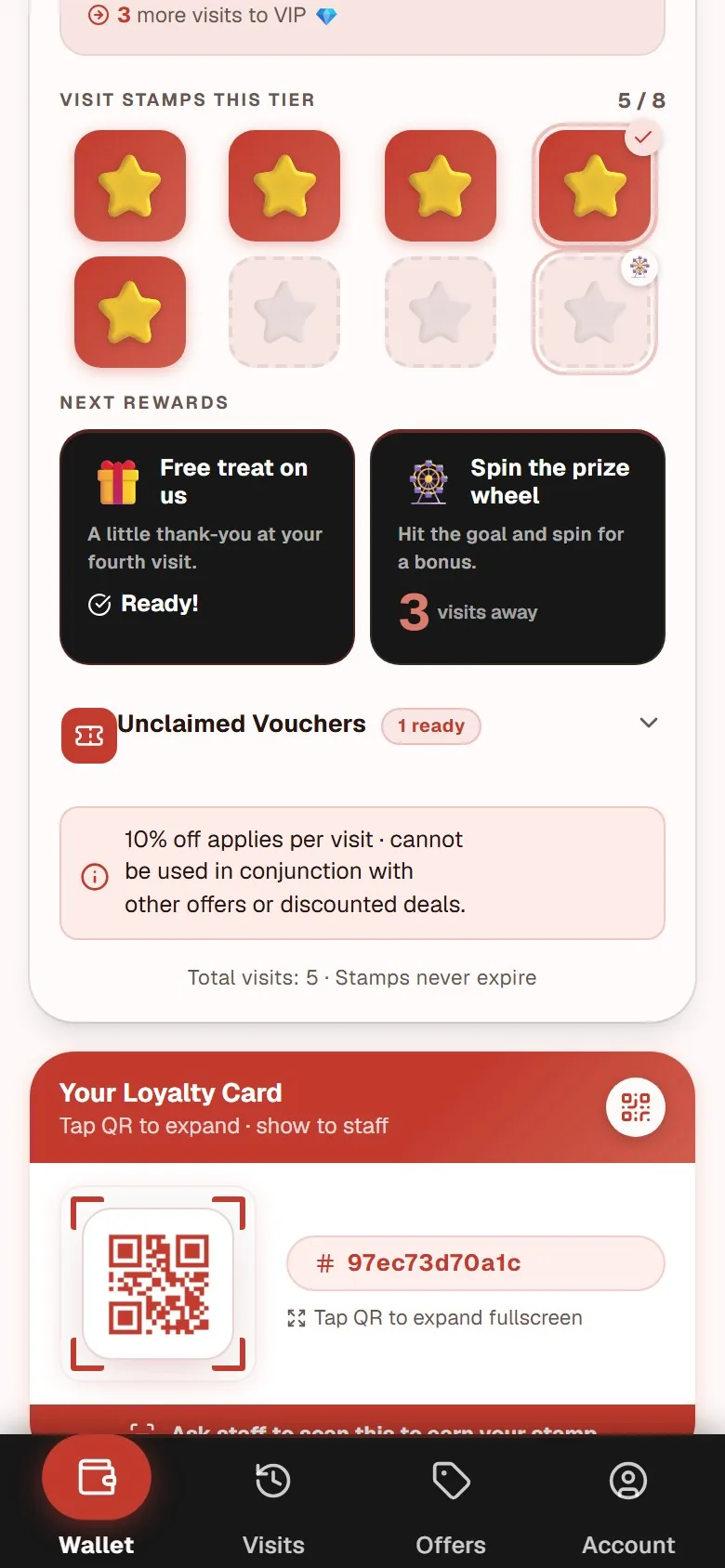
With a digital stamp card, that is exactly what happens. The customer holds up their phone with their loyalty card on screen, and staff scan the QR code in a single motion. The stamp registers immediately, and the customer can see their progress before they even leave the counter. No app download is required: the card opens in the phone's browser, just like a website.
It is precisely in a takeaway context that the absence of an app download matters most. The lower the barrier to joining, the more customers will actually sign up on the spot. Our punch card app page shows exactly what the customer sees when there is nothing to install and nothing to remember.
Rewards that motivate takeaway customers
A good reward at a takeaway venue does not need to be complicated. It should be concrete, easy to communicate at the counter, and feel like a thank-you to a regular rather than a price reduction.
Free item or side. Imagine a burger place that offers a free side of fries after ten visits. The customer has paid for ten meals at full price and receives something that feels like a gesture from the owner, not a discount. That is the key distinction: a free product strengthens the relationship, whereas a percentage discount signals that your normal prices are negotiable.
Free drink. A free drink is popular in the takeaway segment because it is easy to include with the order and low in actual cost but high in perceived value. The customer opens the bag at home and finds something extra they did not expect. It puts a positive ending on the experience.
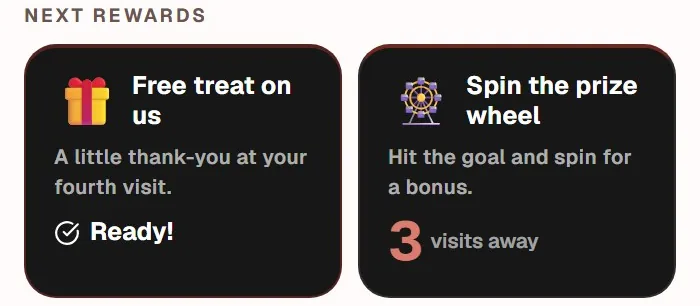
Spin-the-wheel. A spin-the-wheel promotion works well for takeaway customers because the element of surprise makes an otherwise routine transaction feel a little more memorable. The customer does not know exactly what they will win, but they know they will win something. It adds a light moment of entertainment to an everyday visit.
Avoid percentage discounts as your primary reward. Takeaway venues already compete on price and convenience, and a discount-based reward reinforces price logic rather than loyalty to your specific venue.
The QR code that catches customers at the door
In a takeaway venue, there are typically two moments to show the program: when customers order and when they collect. Both should be used.
Place a QR code on the counter, visible to customers while they are ordering. Put another at the collection hatch or on the bag the food is handed over in. The earlier in the visit a customer sees the code, the more likely they are to sign up, because they have a natural moment to scan while waiting for their food.
A simple sticker on the packaging with a short message about the stamp card is an effective and inexpensive reminder that works even after the customer has left. They find it when they unpack the food at home and remember to scan next time.
For a full breakdown of which placements generate the most scans and sign-ups in practice, the guide to QR poster placement is the right starting point.
Getting staff on board
Takeaway venues have busy periods and short customer interactions. It is essential that staff can mention the program within the time that naturally exists at the counter, without spending extra minutes on explanations.
One sentence is enough: "Do you collect stamps?" or "Have you got our stamp card?" Customers who are already signed up show their phone. Customers who are not hear about the program and can join quickly if they are interested. No long sales pitch required.
Give the first stamp on the spot when a customer signs up. A card with one stamp on it is significantly more motivating than an empty card, because the customer can already see that they are underway. Agree on the wording as a team, use it on every shift for two weeks, and it stops being a script and becomes a habit.
Measure and adjust over time
The owner dashboard in MightyLoyalty shows when customers visit you and when they are starting to drift away. This is particularly useful for takeaway venues because the visit pattern quickly reveals who is a genuine local regular and who just stopped by once.
Imagine a takeaway venue that notices customers who sign up on weekdays return within two weeks on average, while weekend customers do so far less often. That is a signal that the weekend customer may be an occasional visitor, while the weekday customer is your real regular. That insight can guide when you put extra focus on the sign-up routine and when it is worth offering a small extra incentive to pull a lapsed customer back.
The Standard plan costs 99 DKK a month, about 13 EUR, and includes unlimited stamping and a dashboard to track visit activity. The Pro plan at 249 DKK a month, about 33 EUR, adds email marketing and automations. There is no binding period and no setup fee, and you cancel in the portal. You can try it yourself at https://loyalty.maiya.dk/ For a full look at what the stamp card itself includes and what the customer experience looks like, the stamp card app page walks through it step by step.
Frequently asked questions
Is a stamp card program actually relevant for a takeaway venue?
Yes, and arguably more so than for many sit-down restaurants. Takeaway customers are already habit-driven and return frequently. But the habit is fragile: a new venue opens, a colleague recommends somewhere else, or a delivery app offers a free first order. A stamp card gives your customer something concrete to come back for: a half-filled card that represents an upcoming free meal. That is a far stronger retention mechanism than good food alone.
What is the best reward for a takeaway venue?
A free item or free side after eight to twelve visits is the most effective starting point for most takeaway venues. It is concrete, easy to explain, and feels like a thank-you to a regular rather than a price reduction. The spin-the-wheel feature is a strong addition because it brings an element of surprise to an otherwise routine transaction. Avoid percentage discounts: they signal that your normal price is high, and they anchor the customer to the price rather than to your venue.
What does a loyalty program cost for a takeaway venue?
The Standard plan costs 99 DKK a month, about 13 EUR, and includes unlimited stamping, a digital stamp card for customers, and an owner dashboard. The Pro plan costs 249 DKK a month, about 33 EUR, and adds email marketing and automations. There is no setup fee and no binding period, so a single month is enough to get a complete picture of what works for your business.