A loyalty programme can be set up in under an hour, but getting customers to sign up requires a different kind of effort. Many owners notice that the first weeks are quiet, even though the programme is technically ready to go. These six practical counter tactics give you concrete ways to change that, starting tomorrow.
Why sign-ups don't happen on their own
Customers are not thinking about your stamp card. They are focused on their order, their payment, and getting on with their day. Your programme is competing in that moment with everything from the phone in their hand to the conversation at the table.
Imagine a café that puts up a QR poster at the counter and waits. A week passes and there are eight sign-ups. That is not a sign the programme does not work. It is a sign that setting up the programme and growing the programme are two separate tasks. Setup is done. Now the recruitment work begins.
The six tactics below are roughly ordered by what tends to deliver the most sign-ups per unit of effort. Start with tactics one and two, and add the others once those habits are in place.
Tactic 1: one sentence from your staff at the counter
The most powerful sign-up tool you have is a team member who asks. Not a sales pitch, just one short and friendly question: "Do you have our stamp card?" That sentence is the reason businesses with engaged staff collect far more sign-ups than those that leave it all to a poster.
The customer who says yes gives you a sign-up opportunity that would not have happened otherwise. The customer who says no does so quickly and without awkwardness. Neither outcome requires more than a few seconds.
For a complete plan on getting your whole team asking consistently, see Get Your Staff On Board: Loyalty Training in 15 Minutes, which covers what to say and which customer questions to expect.
Tactic 2: put the QR code where eyes actually land
A QR poster behind the counter is close to invisible. Your customer's gaze is on the payment terminal, the screen at the till, or the person serving them. The placements that tend to produce the most scans are:
- In front of the payment terminal, at eye level
- On the tables where customers sit waiting for their order
- Laminated on the counter surface itself
- In a small display near the exit
Placement alone can double the number of spontaneous scans, even without staff mentioning the programme. A detailed breakdown of the placements that work best is in The QR Poster: Placements That Get Customers Scanning.
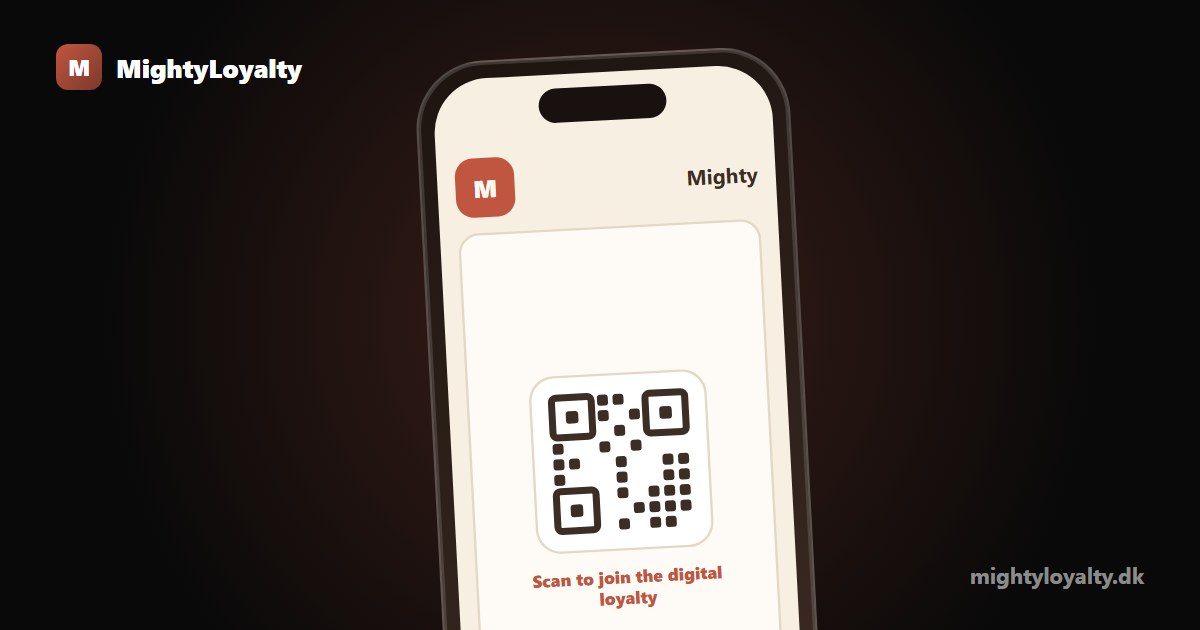
One thing worth communicating clearly: many customers assume a stamp card means downloading an app. MightyLoyalty does not require one. Customers scan and are enrolled directly in their mobile browser, no download needed. That single fact removes one of the most common reasons people hesitate. Read Stamp Card Without App Download: How It Works to understand why it makes a measurable difference to sign-up rates.
Tactic 3: sell the reward, not the programme
"Sign up for our loyalty programme" does not give a customer enough reason to stop and scan. "Collect ten stamps and get your next coffee free" is concrete and motivating.
The reward is why customers sign up. The programme is just the mechanism. Make sure your posters and your team's phrasing mention the reward explicitly and in specific terms.
Imagine two restaurants with identical stamp cards. One says "Scan to join." The other says "Scan to get a free starter after eight visits." The customer sees two very different offers, even though the programme is exactly the same. Be specific, and let the reward do the selling.
Tactic 4: use the payment moment
The payment moment is the point in your customer's flow where you already have their full attention. They are waiting for the transaction to complete. That window is ten to fifteen seconds, and it is long enough for a scan.
A small A5 display at the terminal with the text "Collect stamps and get a free dish. No app. Scan here." provides passive recruitment that requires nothing from your staff. Combine the display with your team's question and you have two channels working for sign-ups at the same moment.
Tactic 5: remember the customers who are already loyal
Here is something that happens in many businesses: the customer who has come in every Tuesday for the last three months has never heard about the stamp card. Not because they would not want to join, but because no one has asked them.
Your already-loyal customers are the easiest group to recruit. They do not need convincing that they like the place. You just need to make them aware the programme exists.
Make sure your staff ask regular customers just as consistently as new ones. A regular who signs up is likely to reach the reward quickly and become an active, visible result in your dashboard.
Tactic 6: use language your customers understand
"Loyalty programme" is industry language. "Stamp card" is more concrete for most people. "Scan and collect stamps" is even more direct.
Use the language that resonates with your specific customer base. For a casual café, "stamp card" or "collect stamps" works better than "loyalty programme." For a restaurant with a slightly more formal audience, "members club" or "regular customer benefits" may land better.
The language on your posters and in your team's question does not need to match the official product name. It just needs to communicate clearly what the customer can expect: that they collect something at each visit and get something concrete in return.
Keep sign-up momentum through the first eight weeks
The first two months are critical. This is when the programme either builds an active base to grow from, or struggles with a small, stagnant group of enrolled customers.
Check new sign-ups once a week. If the number is rising, you are on track. If it is flat after two weeks, check whether staff are asking consistently and whether the QR code is placed where customers will notice it.
A full guide to setting up and making the programme visible from the start is in Create a Stamp Card Programme in One Day.
Frequently asked questions
How many sign-ups can I realistically expect in the first four weeks?
This depends mainly on whether your staff ask consistently. Imagine a café with 80 daily customers: with active staff and a well-placed QR code, 30 to 60 sign-ups in the first four weeks is a realistic target. Without any staff interaction, you will typically see about a tenth of that.
Should I offer an extra bonus for signing up?
Generally not. A sign-up bonus creates an expectation of a discount that is not part of the everyday programme, and it can attract customers who join for the bonus and do not return. The strongest sign-up incentive is the clarity of the reward itself: the customer understands exactly what they are working toward, and that is enough for most people who are open to the programme.
What do I do if sign-ups stall after the first few weeks?
It is normal for sign-up volume to drop once the initial curiosity has passed. Keep the habit alive by making sure staff still ask new customers, not just during the launch week. If there is a sudden drop, it is usually a sign that a team member has stopped asking, or that the QR code has been removed or covered up.