A loyalty programme is an investment: you spend time setting it up, your staff spend seconds scanning at the counter, and you give away rewards to customers working toward a goal. The question is what you get back. This guide gives you four practical metrics and a straightforward method to judge whether your loyalty programme ROI is actually positive.
What do we mean by ROI here?
ROI, return on investment, normally means dividing gain by cost. That is a sensible starting point, but loyalty programmes are harder to measure than a one-off ad campaign because the effects unfold over time and can rarely be separated cleanly from everything else you do in your business.
That does not mean you cannot measure it. It means you need to look at the right signals: changes in customer behaviour, not just a single month of revenue. The four metrics below give a reasonable picture without requiring a complicated spreadsheet.
The four metrics to watch
1. Sign-up rate
The sign-up rate is the share of paying customers who join your programme. Imagine a café with 120 unique visitors a week: if 15 to 20 sign up during the first month, that is a reasonable start.
The sign-up rate tells you whether the programme is even reaching your customers. If it stays low after four to six weeks, the most common causes are staff not asking consistently, the QR poster being placed poorly, or the reward not looking attractive enough from the outside. The guide Create a Stamp Card Programme in One Day covers visibility and setup from the very beginning.
2. Redemption rate
The redemption rate shows how many enrolled customers actually reach the reward. You calculate it as the share of active cardholders who have redeemed at least one reward since joining.
A healthy redemption rate means customers are engaged enough to return the required number of times. A very low rate usually signals that the stamp goal is set too high, or that the reward does not feel worth waiting for.
3. Visit frequency for enrolled customers
The most important question is whether enrolled customers visit more often than non-enrolled ones. Compare how many times your active members have visited in the last 30 to 60 days against what you would typically expect from a new customer who has never heard of your programme.
Imagine a restaurant that normally sees a new customer once or twice in the first six weeks, then loses half of them. Active programme members should return with shorter gaps between visits. Even one extra visit per enrolled customer per quarter adds up meaningfully over time.
4. Active versus inactive members
How many of your enrolled customers are active, meaning they have scanned within the last 60 days? A programme with many sign-ups but few active members is good at recruiting but not at retaining. An active share of 50 to 70 percent of all enrolled customers is a healthy sign. If it drops below 30 percent, it is time to review the reward and the stamp goal.
A simple ROI method
You do not need an advanced spreadsheet to judge ROI. Here is an approach that takes five to ten minutes.
Step 1: Estimate extra revenue from additional visits
Take your number of active enrolled customers and consider whether they average at least one extra visit per quarter compared with a typical non-enrolled customer. Imagine 50 active members: one extra visit per member per quarter gives you 50 additional visits at your average transaction value. Even with a modest average spend, that is a meaningful number over a quarter.
Step 2: Calculate the reward cost
Reward cost is usually the smallest item in the calculation. A free coffee or similar product has a low production cost, and not all enrolled customers redeem a reward within any given quarter. Use your actual production cost, not the retail price.
Step 3: Compare with the platform cost
What Does a Loyalty Programme Cost? covers the pricing models in detail. The Standard plan is 299 DKK per month and the Pro plan is 399 DKK per month. By comparison, a handful of extra visits per week from engaged enrolled customers typically covers the subscription on its own. The calculation is rarely close: there is either clear surplus, or a clear problem with sign-ups, activity, or redemptions.
When should you adjust your programme?
Three signals tell you something needs changing.
Sign-up rate is low after four weeks. This is most often a staff issue. Your team is forgetting to ask, or they are unsure what to say. Work through the guide Get Your Staff On Board: Loyalty Training in 15 Minutes and run a short refresher with the team.
Redemption rate is very low. The stamp goal is probably too high, or the reward is not compelling enough. Try lowering the goal by two to three stamps and observe the effect over the next four to six weeks. You will find advice on picking the right reward in Choosing the Right Reward for Your Stamp Card.
Active share is falling over time. Some drop-off is natural in any programme. A sharp decline over three to four months is a signal that customers are losing momentum before reaching the reward. Consider lowering the stamp goal or adding a mid-point reward, for example a small bonus at the halfway mark.
Numbers give direction, not answers
None of the metrics you see in your dashboard are absolute truths. A loyalty programme for a hair salon that sees customers four times a year looks fundamentally different from a café with daily visitors. Use the numbers as indicators for your specific business and compare yourself over time, not against a hypothetical average.
The important thing is to have a fixed starting point to measure from. Note the numbers from your first two months and use them as a reference when you check whether the programme is moving in the right direction. A programme that grows slowly is better than one that is stable but going nowhere.
Frequently asked questions
How quickly can I expect to see results?
Most businesses can see early signals within four to eight weeks, but this requires a reasonable sign-up rate from the start. If the programme has fewer than 30 to 40 active enrolled customers, the data set is too small to draw meaningful conclusions. Spend the first few weeks making sure staff ask consistently and that the QR poster is placed where customers will notice it.
Do I need to integrate with my point-of-sale system to measure ROI?
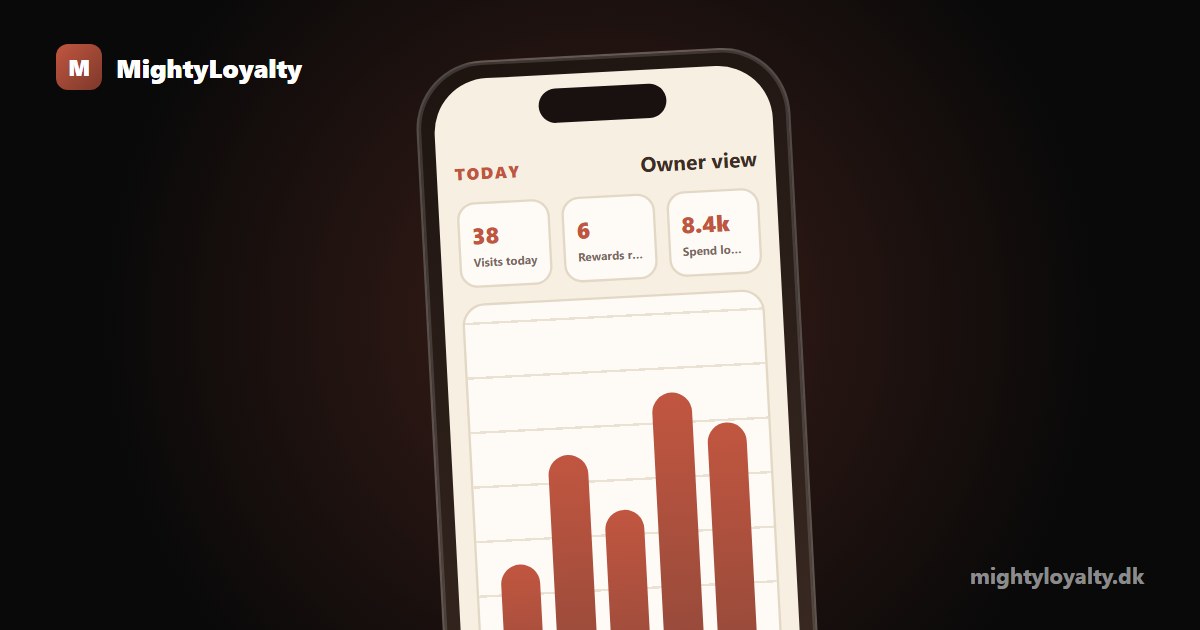
No. The core overview of enrolled customers, active members, visits, and redeemed rewards is available directly in the MightyLoyalty owner dashboard. You do not need a POS integration to judge whether your programme is creating real changes in customer behaviour.
Is a loyalty programme only worth it for large businesses?
No, and the reverse is often true. A small café with 60 to 80 daily customers can see a positive ROI relatively quickly, because enrolled customers represent a meaningful share of total visits, and because the owner and staff usually know the regulars well enough to notice when they are coming in more often. The programme does not need to scale to thousands of users to pay for itself.