A tiered loyalty program gives your most engaged customers something to aim for beyond their next free coffee. A bronze member wants to reach silver; a silver member is eyeing gold. That simple mechanic shifts the motivation from short-term (the immediate reward) to long-term (the status and recognition that come with reaching a higher level). This guide shows you how to design a tier structure that actually works for a restaurant, a cafe, or a salon loyalty program.
Why loyalty tiers work
A flat stamp card program is linear: customers collect stamps, claim their reward and start again. It works, and it is the right structure for many businesses.
Tiers add a new motivator on top: aspiration. Customers no longer see only when they earn their next reward. They also see when they move up to a new category and what that means for their benefits.
It also lets you acknowledge what a flat program cannot: not all customers are equal. A guest who visits four times a week is investing considerably more in your business than someone who drops in once a month. A tier system gives you a concrete way to reflect that difference and to show that you notice it.
Three tiers is usually enough
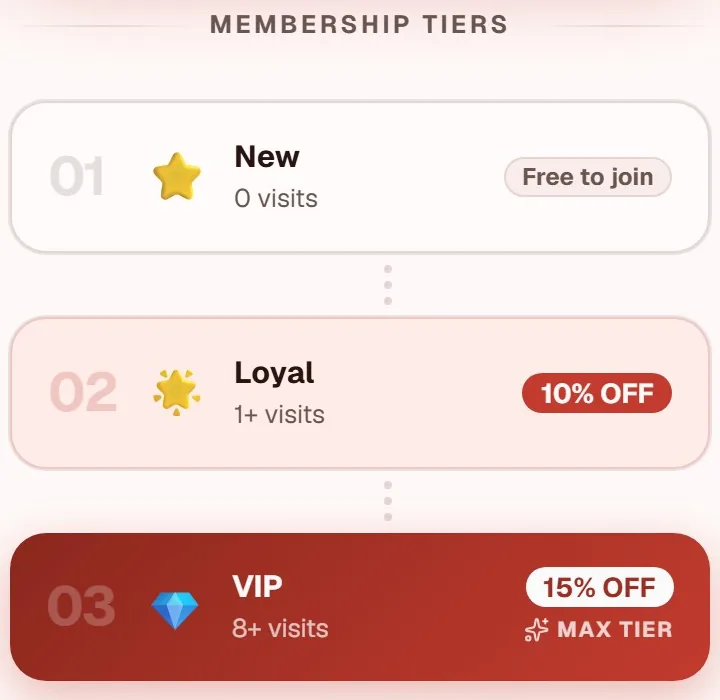
The more tiers you have, the harder the program is to communicate. A cafe with five levels from "New Member" to "Platinum" creates more confusion than motivation. Three tiers, bronze, silver and gold, are the balance that works for most businesses.
Bronze is the entry point. Every new sign-up starts here. The threshold is low by design: customers should feel close to something better, not far from it.
Silver is reached after a defined number of visits or stamps. The customer has demonstrated that they are more than an occasional visitor. Silver should feel like a real upgrade, not a marginal improvement.
Gold is reserved for your most engaged guests. Here you offer something that is not about price: exclusive access, personal recognition, or a benefit that exists only for gold members.
What each tier should offer
Each tier's reward should feel like a genuine step up. It helps to think in categories rather than percentages.
Here is an example for a restaurant:
- Bronze: Ten stamps earns a free starter. Concrete, easy to explain, and easy to mention at the counter.
- Silver: Ten stamps earns a free dessert plus early access to weekend reservations before they open to everyone else.
- Gold: Ten stamps earns a free starter and dessert. Gold members are also invited to an exclusive regulars dinner once per quarter.
The key detail: the stamp count does not change across tiers. It is always ten stamps. What changes is what those ten stamps are worth. That keeps the program easy to explain at the counter and easy for the customer to understand.
What you fill the ladder with depends on your trade. A restaurant fills it with food; a salon fills it with time and access, because an appointment at a busy hour is worth more to a regular than a discount. Loyalty for nail salons covers what clients in that trade actually value, which is where the content of each rung should come from.
When does a customer move up
The threshold for moving between tiers should reflect realistic visit patterns for your customers. Setting the gold threshold at 200 stamps is counterproductive if your typical regular visits twice a month: they will never reach it, and the tier structure loses its motivating effect.
A useful check: would your most loyal current regular reach gold within twelve months if they maintained their current pattern? If the answer is yes, the threshold is reasonable. If not, it is probably too high.
Imagine a cafe where the typical regular visits three times a week. A threshold of 20 visits for silver works out to about seven weeks: demanding enough to require commitment, but achievable within a single season. A threshold of 60 visits for gold is roughly five months, which is realistic for a truly devoted regular.
For a restaurant with weekly guests, adjust accordingly. Businesses where attendance is close to daily need the widest spacing of all, and loyalty programs for fitness studios shows how to set attendance tiers when a committed member turns up several times a week. The key is that each tier is achievable for the customer who genuinely deserves it, and worth reaching for everyone else.
Communicate the tiers clearly
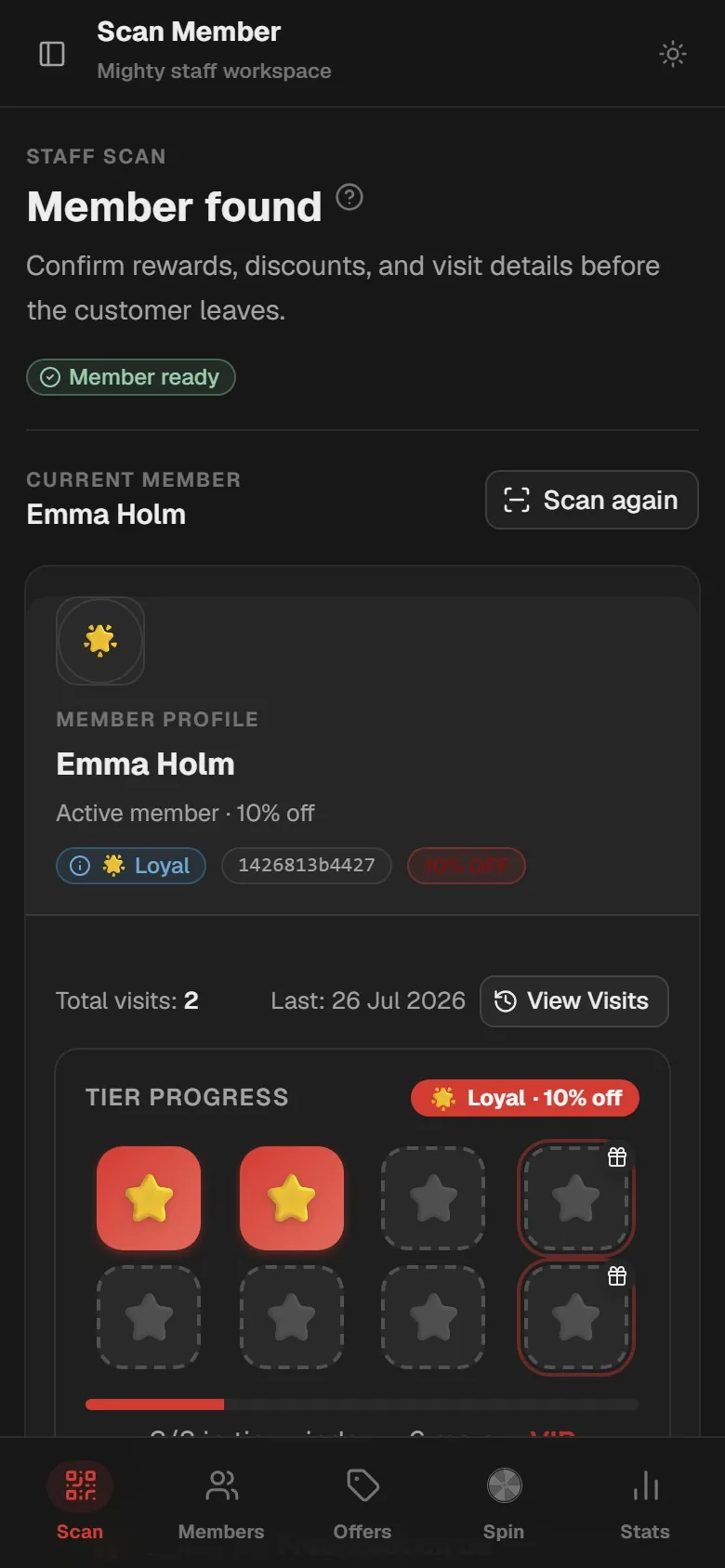
A tier system is only as strong as the communication around it. Customers must always know where they stand and what it takes to move up. In MightyLoyalty, customers see their current status and progress directly on their digital card: no extra click required, no explanation needed from staff.
Staff should be able to explain the whole structure in two sentences. A useful exercise is to agree on a short phrase everyone uses: "You are on silver now. Another twenty stamps and you move to gold, which includes a quarterly exclusive dinner." If staff cannot say that quickly and accurately, the structure may be too complex.
Write the tier names and thresholds on a single card by the register so nobody has to guess on a busy shift. If a new hire cannot read it once and repeat it correctly, simplify the structure rather than the explanation.
Measure whether it is working
Three simple metrics will tell you whether the tiers are doing their job.
Bronze to silver conversion: What proportion of bronze members reach silver within six months? A low rate suggests the threshold is too high or the silver benefit is not compelling enough.
Visit frequency by tier: Do silver and gold members visit more often than bronze members? If there is no clear difference, the tiers are not driving increased frequency.
Churn by tier: Customers with higher status are harder to lose, because they have invested more in the program. Check whether gold members return more reliably than silver, and whether silver is more stable than bronze.
The Standard plan costs 99 DKK a month, about 13 EUR, and includes full stamp card functionality and a dashboard to track visit patterns. The spin wheel is included in Standard and works well as a bonus reward at higher tiers; the Pro plan at 249 DKK a month, about 33 EUR, adds email marketing and automations. There is no binding period and no setup fee, and you cancel in the portal.
For a step-by-step method to measure whether your loyalty program is generating a real business return, see our article on measuring loyalty program ROI.
Frequently asked questions
Can a simple stamp card program include tiers?
Yes. Tiers do not require a complicated system. You define when a customer moves from one tier to another and what the benefits are at each level. The stamp mechanic stays the same: ten stamps earns a reward. What varies is the content of that reward and any additional perks that come with the tier. Start with two tiers if three feels like too much, and add the third once the first two are running smoothly.
What do I do with customers who never move beyond bronze?
Bronze members are still customers and still part of your program. Not every guest has the frequency or motivation to reach silver or gold, and that is fine. Bronze is still better than no program at all. Use the tiers to recognize those who go the extra mile, not to deprioritize those who do not. Customers who are drifting away can be brought back with a direct offer, as described in our guide on winning back lapsed customers.
Should every tier use the same stamp period?
For most businesses, keeping the same stamp mechanic across all tiers is the simplest approach. Customers collect ten stamps and claim a reward, whether they are on bronze, silver or gold. What varies is what that reward is and what additional perks come with their tier level. This keeps the program easy to understand for customers and easy to manage for staff.