Reactivating lapsed customers is one of the most cost-effective ways to grow your loyalty program's impact, because you are working with guests who already know and like your venue. The challenge is that most owners cannot identify who their inactive members are or when they stopped returning. A digital loyalty program gives you the data to act with precision, rather than relying on guesswork.
Who counts as a lapsed customer?
Not every guest who missed a few weeks is lapsed. Many are busy, travelling, or simply waiting for the right occasion. A genuinely lapsed customer is a guest whose visit pattern has broken from what you would normally expect of them.
Picture two members in your loyalty program. One visits twice a week; the other came four times and has not returned since. Both might have a gap of three weeks, but only one has a broken pattern. That is the guest who deserves a reactivation message.
Set your threshold to match your business type:
- Café with daily regulars: 30 days without a visit
- Restaurant with occasional diners: 60 days without a visit
- Salon or treatment venue: 90 days without a visit
The threshold determines whether your campaign fires too early, bothering guests who would return on their own, or too late, missing the window when your venue is still fresh in their minds.
Finding your inactive members with data
A paper stamp card cannot give you the list. A digital stamp card app can.
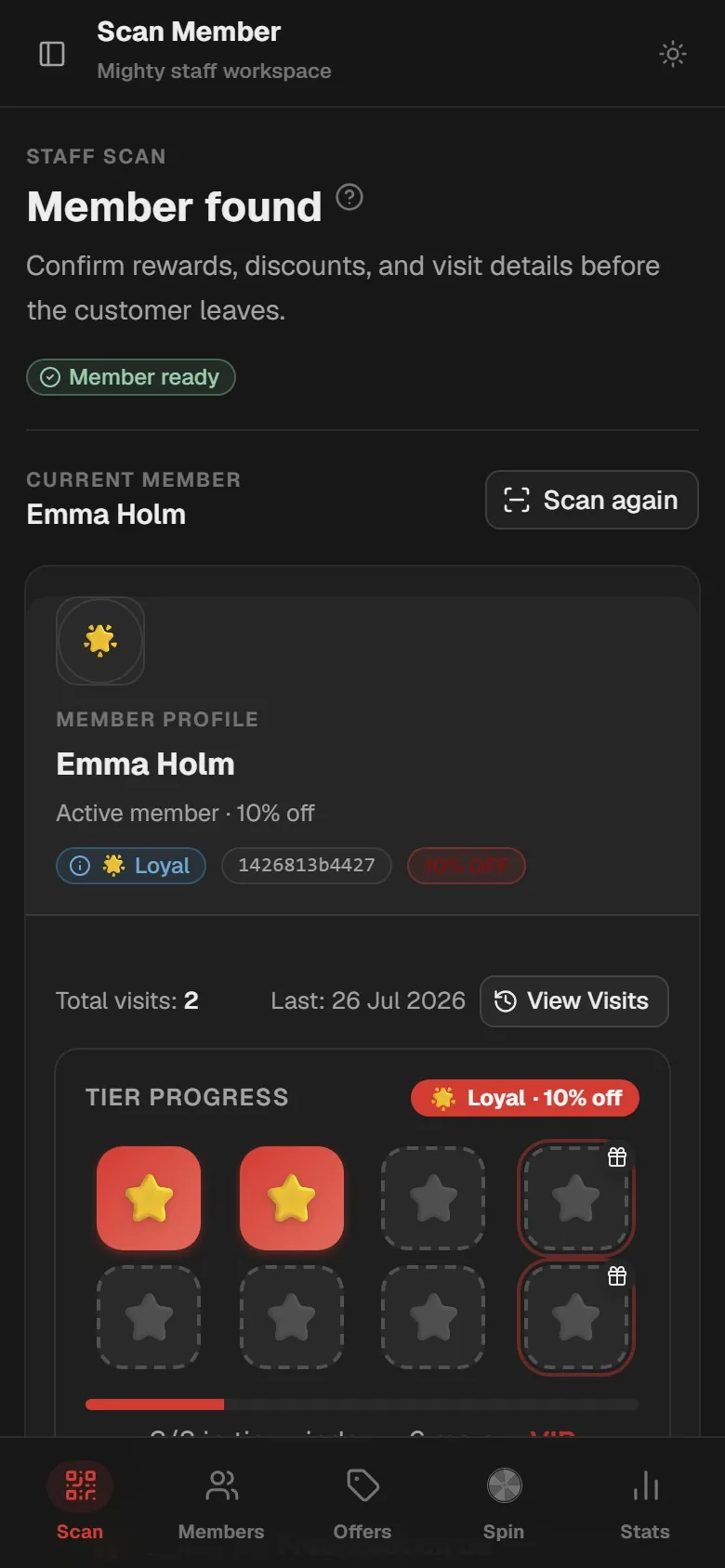
Log in to your dashboard and filter members by the date they were last seen. That list is the starting point for all reactivation work. Say you have 300 enrolled members and 80 have not visited in 45 days. That is not a crisis; that is an opportunity.
Look at those 80 with a few questions in mind:
- When did they enrol, and how many stamps did they collect?
- Are any of them close to redeeming a reward they have not yet claimed?
- Are there patterns in when they last visited (season, day of the week)?
Guests who are halfway to a reward are far easier to bring back than those who never got close to their goal. That sub-group is your primary target.
Win-back is only one of the questions this dashboard answers, and guest data: your most underused marketing channel covers the others worth asking of the visit history you already have.
Three reasons guests drift away
Before you reach out, it helps to understand what typically happens.
They forgot. Life gets busy, habits shift, and your venue slips down the priority list. No bad experience involved; they simply have not thought about it. These guests are the easiest to reactivate because a single, well-timed reminder is often enough.
They had a negative experience. A disappointing dish, a long wait, an awkward interaction with staff. These guests are not necessarily lost, but they need more than a reminder. A message that acknowledges the gap and invites them back with something tangible works better than a generic campaign.
Their habits have changed. A new workplace, a house move, or a competing venue they now prefer. Here the effort may not pay off unless you can offer something their new local cannot.
You will not know in advance which group a given guest belongs to. Write for the most common one: those who simply forgot.
Running a reactivation campaign step by step
A reactivation campaign does not need to be complex. The most effective version is simple and direct.
Step 1: Build the list. Filter your loyalty dashboard to members who have not visited within your chosen threshold and who have at least one recorded visit. New members who enrolled but never returned are a separate case.
Step 2: Write one message. Keep it to seven lines or fewer. Cover three things: acknowledge that some time has passed; offer something concrete (a double stamp on their next visit, or a bonus when they hit their next milestone); and include a one- to two-week deadline. The deadline gives them a reason to act now rather than "sometime soon."
Step 3: Choose your channel. Email is the obvious choice if you have addresses for your enrolled members. For a thorough guide to email messaging for loyalty guests, see Email marketing for restaurants: get guests to return.
Step 4: Send and log the date. You cannot measure what you have not recorded. Note the date and number of recipients, then check visit numbers over the following two weeks.
Step 5: Flag those who did not respond. Members who do not return within four weeks can receive a second attempt 60 days later, or be quietly set aside.
The reward that brings them back
A discount is the easiest solution, but not always the best one. Discounts lower the perceived value of your menu and train guests to expect a negotiable price.
Alternatives that work without undermining your pricing:
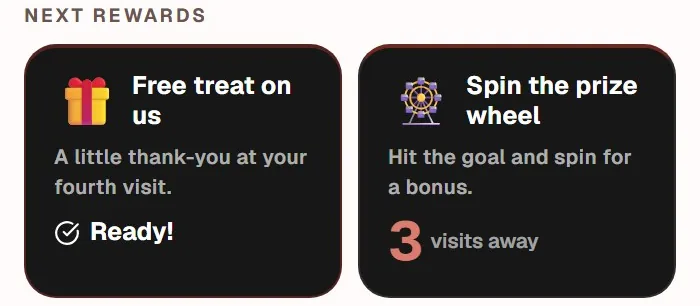
- A double stamp on their next visit: the guest progresses faster toward their reward without paying less
- A bonus milestone: "Visit three times in August and earn an extra stamp"
- Early access to a new dish or a seasonal menu not yet announced publicly
The best reward gives guests a specific reason to return that is not a price saving. That kind of incentive keeps your menu's value intact and signals that you remember and appreciate them.
Measure the results and improve each round
A reactivation campaign is not a one-off event. It is a routine you run two to four times a year and refine as the data comes in.
Track three things:
- Return rate: how many of the recipients came back within two weeks of receiving the message?
- Timing: did they return in the first week or the second?
- Reward redemption: did they reach a reward, and did they claim it?
Imagine you message 60 lapsed members and 15 of them visit within two weeks. What is that worth? Take your average order value, multiply by 15, and compare it against the effort of writing and sending the message. That gives you a concrete basis for the next campaign. You will find a step-by-step method for that calculation in Measuring Loyalty Program ROI: Does It Pay Off?.
No campaign brings back 100 per cent of the list, and that is not the goal. The goal is to recover the guests who genuinely wanted to return but needed a nudge. That is a far cheaper path than recruiting fresh members from scratch, which Get More Regulars: 7 Tactics That Actually Work covers in detail.
Frequently asked questions
When is it too late to reactivate a lapsed member?
There is no hard rule. Members who have been absent for more than six months will typically need more than one message, and many will not return regardless. A realistic approach is to focus reactivation on guests who have been away for between 30 and 90 days. They still remember your venue clearly and have not yet settled into a firm routine elsewhere.
Can I reach out even if I have no special reward to offer?
Yes. Even a simple reminder that their stamps are waiting and they are close to a reward is enough in many cases. Members do not always know the status of their stamp card, and a message recalling what they have already earned removes the barrier. No extra bonus is needed, just a clear and honest nudge about what is waiting for them.
What is the risk of sending too many reactivation messages?
Members who receive too many messages will unsubscribe or ignore future outreach. One to two reactivation messages per quarter is a safe upper limit for most venues. If a guest has not returned after two attempts with a reasonable gap between them, it is better to leave them alone than to risk pushing them to opt out of the program entirely.