Building loyalty without discounts is not just possible; it is often the more durable strategy for restaurants and cafés. Discounts are straightforward and quick to set up, but they send an unintended signal to customers: that your normal price is negotiable. This guide explains what you can use instead, and why experiences and exclusivity tend to motivate regulars more effectively than price cuts.
The hidden cost of discount rewards
A discount is easy to understand, which makes it tempting as the core of a loyalty program. Customers collect stamps and get ten per cent off their next visit. Clear, measurable, and simple to explain at the counter.
But discounts carry two costs that rarely get mentioned openly. The first is that they attract customers who are primarily motivated by price. Those customers leave the moment a competitor offers a better deal, because their loyalty is tied to the saving, not to your venue.
The second cost is what discounts signal about your pricing. When you reward with a percentage off, you are implicitly telling customers that there is room in your menu prices. Over time, the normal price starts to feel like the "expensive" price and the discounted price starts to feel like what things should cost. That perception is very difficult to reverse, and it gradually erodes the value of your offering.
This is not an argument against discounts entirely. A time-limited discount to pull customers in during a quiet period can work well as a campaign. But building the core of your loyalty program around discounts rarely produces the kind of long-term regulars most hospitality businesses are looking for.
The free product: a gift, not a discount
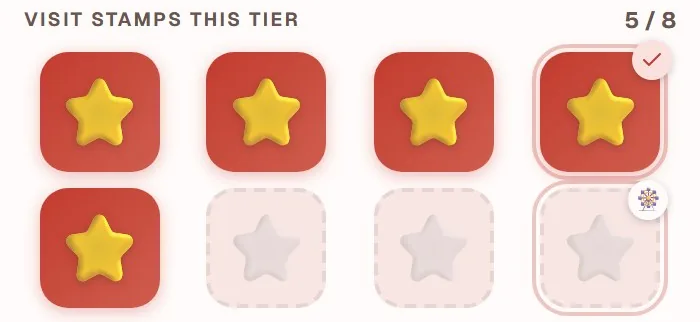
The most popular alternative to the discount is the free product reward: customers collect ten stamps and receive the next coffee free, a dessert, a sandwich, or a pastry of their choice.
Psychologically, this is a completely different situation. The customer has paid full price for all ten visits. The reward arrives as a gift, not a price reduction. That distinction shapes everything: a gift builds a relationship, while a discount reduces a price.
Imagine two cafés side by side. The first says: "Collect ten stamps and your next coffee is on us." The second says: "Tenth visit? Here is ten per cent off." Both cost the owner roughly the same. But customers experience the first as "they appreciate me and want to give me something," and the second as "the price is lower than usual." Those are two very different relationships with a place.
For a detailed breakdown of which product rewards work best for different venue types, see our guide to choosing the right reward for your stamp card.
Experience rewards: something you cannot buy at the counter
An experience reward is something customers cannot order from the menu or pick off a shelf. That is precisely what gives it its power: it is not a discount and not a substitute for something you already sell. It is something exclusive, available only to people in your program and to nobody else.
Examples that work in practice:
- An exclusive tasting evening or menu preview for the most active members in the program
- A table that is always reserved for loyalty members during busy periods
- A personal introduction to a new seasonal dish from the owner or chef
- First access to a new drink or dish a week before it goes on the main menu for everyone
Imagine a café that invites its twenty most active regulars to a members-only breakfast, before the café opens to the public, once per quarter. It takes an hour of preparation and a couple of dozen pastries. In exchange, it creates a story that regulars share with each other and with new customers: there is something genuinely special about coming here.
Experience rewards take more planning than a percentage discount, but they build a different kind of connection to a place, and that connection is much harder for a competitor to replicate than a pricing model.
Exclusivity and belonging
An exclusivity reward sends a direct message to the customer: she is not just any customer. It can be delivered in very simple ways and costs almost nothing to implement.
Examples:
- Priority booking before reservations open to the public
- A loyalty badge or member status visible in the app
- A weekly hidden dish on the chalkboard, shared only with members in the loyalty program
The underlying motivation is belonging. People return to places where they feel recognised and valued. That feeling does not cost a percentage of your margin; it costs attention and a small amount of creative thinking.
For a broader look at what drives customers to come back in the first place, our guide to customer loyalty in your café is a good starting point.
Combine product and experience rewards in a tier
You do not have to choose one or the other. Many venues use both: a free product as the base reward and an experience reward as a milestone prize.
One example: ten stamps earns the free coffee or pastry. After the customer has completed their third stamp card, they receive an invitation to the next tasting evening or gain priority status for reservations. The everyday reward is concrete and easy to understand; the milestone reward is exclusive and creates a new reason to stay engaged with the program over the long term.
If you haven't set up your digital stamp card yet, the stamp card app page gives a quick overview of what you can configure from day one.
For a complete overview of all reward types, from free products to experiences and gamification mechanics, our post on the best rewards for loyal customers covers all the options in one place.
If you are unsure whether stamps or points work better as the collection mechanic alongside these reward types, we compare the psychology of both in points or stamps: what motivates customers most?.
Frequently asked questions
Can a loyalty program work without any discounts at all?
Yes. The most effective programs for restaurants and cafés are often built entirely on free products, experience rewards, and exclusivity. Discounts are not necessary, and they introduce pricing perception problems that are hard to undo. If you already run a discount-based program, you can transition gradually: keep the current reward for existing members and introduce the new reward structure for new sign-ups.
What experience rewards work for a small café or restaurant?
The simplest ones work best. A members-only breakfast four times a year, early access to weekend reservations, or a permanently reserved table during busy periods requires minimal extra effort and communicates exclusivity clearly. You do not need large events. A weekly hidden dish shared only through the loyalty app is more than enough to create the sense of belonging that keeps regulars coming back.
What if my customers already expect discounts?
Frame the change as an upgrade, not a removal. Tell them you are replacing the monthly discount with something money cannot buy: access, experiences, and the personal recognition that comes with being a regular. Most customers respond positively because the new offer appeals to something more fundamental than saving money. Customers who came purely for the discount will drop off, but those are the ones who would have left at the first sign of a better deal from a competitor anyway.