Loyalty app pricing ranges from completely free to thousands of kroner per month, which makes it hard to know what is reasonable and what is simply overpriced. This article walks through the three pricing models actually used in the market, what is typically included at each level, and what you should look for before making a choice.
The three loyalty app pricing models
When you compare loyalty apps, you primarily encounter three pricing models. They look very different from one another, but none of them is automatically the right fit without knowing your own transaction volume.
Flat monthly fee is the simplest model. You pay the same amount whether you stamp ten or a thousand guests per month. The cost is predictable, and you know your exact budget going into next month. For a café with consistently high traffic, this is usually the cheapest model per individual interaction.
Pay-as-you-go (per stamp) works the opposite way: you pay nothing in months with low volume and more when things are busy. It suits businesses that stamp sporadically or run a seasonal operation. The downside is that you lose the predictability that makes budgeting straightforward.
Per-member pricing is a third model that sounds cheap at the start. You pay a small fee for every loyalty card member stored in the database. The problem emerges once the program starts working: the more guests who sign up, the higher your bill. A café that builds a thriving loyalty program can find itself penalised by its own success.
What you typically get at each price level
Price alone is not enough information. Two loyalty apps at the same monthly cost can deliver very different functionality.
Free and very cheap solutions typically impose limits on the number of members or stamps, display the vendor's own branding on your card, and offer no real customer support. This can work for a quick test, but is rarely a solid foundation for a real loyalty club. If you want to know exactly what hides inside the free offers, our guide to free loyalty programs walks through precisely what "free" ends up costing you over time.
Mid-tier solutions give you your own branding on the card, a fixed allowance of stamps or members, and a simple dashboard. Functionality is often limited to the basics: scan, stamp, reward. This can be sufficient for a single small business, but many in this segment outgrow the restrictions quickly once their membership base starts to grow.
From about 100 to 250 kroner per month is the level for fully equipped web-based loyalty apps with unlimited stamping, a fully branded loyalty card, a QR poster and print materials, a statistics dashboard, and options for personalised offers and campaigns. This is the segment most independent owners land in, because the price is predictable and includes what actually brings guests back through the door. Our own loyalty app pricing sits in this band, so you can see which features fall on each side of the line.
More expensive solutions with POS integration or app download require guests to download from the App Store or Google Play and tie you closely to one platform. Onboarding is typically slower, and you depend on the vendor still prioritising your type of business. This makes sense for larger chains with dedicated IT resources, but is overkill for the independent owner.
What it will actually cost your café
Price is easiest to understand when you set it against your actual volume. Imagine a café with 50 to 80 visits per day and an ambition to build a regular customer base over the next six months.
A flat monthly fee of 99 DKK spread across, say, 500 monthly stamps gives a very low cost per interaction, and the more the program is used, the better the ratio becomes. A flat price rewards you for growth, rather than penalising you the way a per-member model would.
A per-stamp or per-member model looks kinder on a quiet month, but the arithmetic turns against you exactly when the program starts working. Take whatever per-stamp rate a vendor quotes you, multiply it by those same 500 stamps, and hold the total up against a flat monthly fee. That is the structural problem with usage pricing on a loyalty product: the thing you are paying for is guests coming back, so the better it works, the more it costs.
That is why MightyLoyalty is sold on a flat monthly price only. A flat fee is the only model that does not quietly punish you for promoting your own loyalty card.
What is not always included
The price on the front of an offer is rarely the full picture. These items are not always included and can stack on top:
QR poster and print materials: Some solutions invoice the design and printing of sign-up materials separately. Ask specifically whether a print-ready PDF is included in the subscription, or whether you have to design it yourself.
Setup fee: Most web-based solutions carry no setup fee. Custom-built solutions and POS-integrated programs often charge a one-time onboarding fee before you go live.
Extra locations: If you run two sites, always ask whether both are covered by one plan or whether the second location is invoiced separately.
Support: Free and cheaper plans typically lack access to real customer support. A QR code that stops working on a Friday evening with a queue at the counter is expensive in lost goodwill and missed stamps, even if the nominal price was low.
For a broader look at which solution categories exist and what each typically includes, our overview of loyalty solutions and pricing provides a solid foundation to build on.
When the price pays off
A loyalty program is not an expense in itself. It is an investment in returning guests. The question is not "what does it cost?" but "what does it take for it to pay off?"
To cover a subscription at 99 DKK per month, the program needs to generate very little. At coffee-shop margins, where a cup leaves you roughly 30 kroner of gross profit, three or four extra visits across your entire guest base pay for the month. At lunch prices, a single extra guest does it. That is the whole hurdle, and everything beyond it is gain.
This is the part of the arithmetic that changed as web-based tools replaced custom builds. When a loyalty program meant a bespoke development project or a chain-grade platform, an owner genuinely had to sit down and work out whether it would earn its keep. Below 100 kroner a month the calculation stops being interesting, which is the point.
That is the logic behind why loyalty programs are profitable investments for cafés and restaurants that already have returning guests: you do not need to double your revenue, you just need to move some visits from "maybe" to "yes."
If you want help thinking through when a loyalty program pays off, our guide to loyalty program cost and the maths behind it walks through the logic from the ground up.
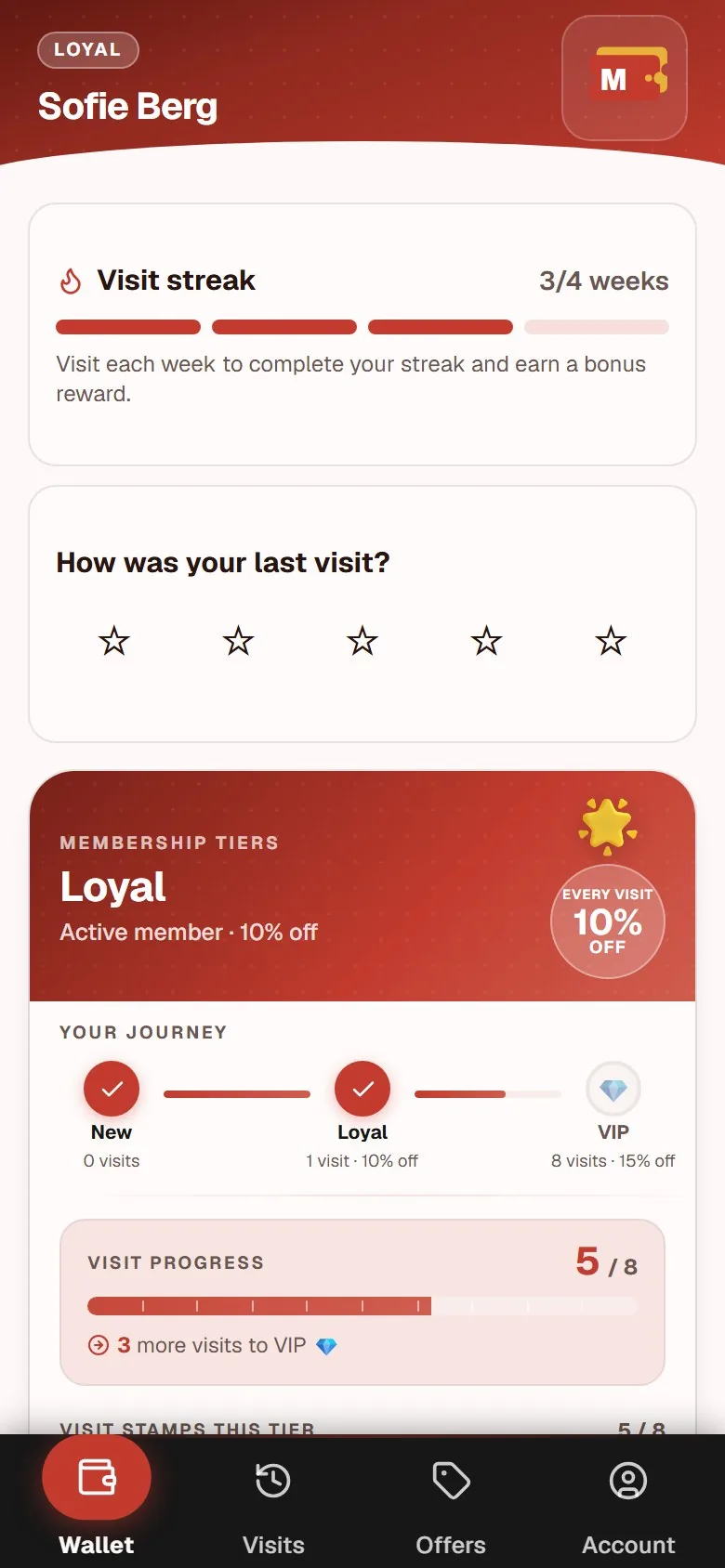
Before comparing prices, it helps to see a real stamp card app in action. Our product page shows the card, the counter poster, and the owner dashboard.
You can see the current plans and prices for MightyLoyalty directly on our pricing page and try a real stamp card in action at loyalty.maiya.dk.
Frequently asked questions
What is the cheapest serious loyalty app?
The cheapest serious loyalty app without the hidden catches, meaning no ads, no member cap, and no vendor branding on your card, typically starts at 99 DKK per month with unlimited stamping. Cheaper solutions either cap the number of guests, carry vendor branding, or lack support, giving them a hidden cost in the form of lost revenue and wasted time.
Is a per-stamp plan cheaper for a new business?
Only in the months where nothing happens, which is not the outcome you are paying for. Take the per-stamp rate you are quoted, multiply it by the number of stamps you realistically expect in a busy month, and hold that total up against a flat 99 DKK. The busier you get, the worse usage pricing looks, which is the opposite of what you want from a loyalty product. MightyLoyalty is sold on a flat monthly price for exactly that reason: growth costs you nothing extra.
What does it cost to run a loyalty app across two locations?
It depends on the platform. Always ask what the extra location costs before you sign up. Many platforms invoice a separate plan for each site, while others offer a multi-location model with a combined price. Make sure to get the answer confirmed in writing before committing.