Facebook marketing for restaurants no longer means a post that reaches all your followers on its own, but Facebook is still where many locals look you up and ask each other for advice. For a small restaurant or cafe in Denmark, Facebook today is less an advertising channel and more a neighbourhood notice board: a page with the right details, a place in the local groups, and a calendar of events. This guide covers what still works, and how to turn someone who found you on Facebook into a guest who comes back.
Why Facebook still matters for a local restaurant
Instagram and TikTok are about being seen. Facebook is more about being found and being recommended. When someone in a neighbourhood group asks "where can we get a good brunch this weekend?", it is one of the few places online where a neighbour's recommendation lands right in front of a person who is about to decide.
It is also where many of your guests over 40 spend their time. If you have read our guides to Instagram for restaurants and TikTok marketing for restaurants, think of the split like this: TikTok finds new eyes, Instagram keeps in touch with people who follow you, and Facebook is where the local community talks about you, even when you are not part of the conversation.
So do not run Facebook the way you run the other channels. Fewer posts, more presence.
Your restaurant Facebook page: get the basics right
Before you think about posts, your page has to answer the questions a new guest has. Plenty of people check your Facebook page as often as your website, and a page with the wrong opening hours loses you guests without you ever hearing about it.
- Opening hours, including public holidays. Christmas, Easter and the other Danish public holidays are when a wrong listing hurts most. Update the page before you close, not after.
- Address and phone number, written exactly as on Google. Name, address and phone number should match everywhere. Our guide to local SEO for restaurants explains why that affects where you show up in search.
- A link to the menu. An up-to-date menu is what most visitors want. Link to the one on your website so you only ever correct it in one place.
- A real photo of the place. The profile and cover photos should show what it looks like from the door, not a logo on a white background.
- Reply to messages. Many people message a page on Messenger to ask about a table, allergens or opening hours. If you run an international place in Copenhagen, expect questions in both Danish and English. A quick reply is often the difference between a booking and a guest who goes elsewhere.
Local groups: where the conversation happens
Most Danish neighbourhoods and towns have one or more Facebook groups where residents share news, ask for a plumber and recommend places to eat. Many are in Danish only, so a short post in Danish goes a long way even if your page is in English. These groups are the most valuable part of Facebook for a local restaurant, and the part most often used badly.
Read the rules first. Many groups ban advertising completely, or only allow it on certain days. A post that breaks the rules gets deleted, and you have spent goodwill with an admin you may need later.
Be a neighbour, not an advertiser. Take part as the person who runs the place on the corner: answer when someone asks about something you know, and mention yourself when it is relevant. A post saying you have reopened after the holidays, or that you now bake gluten free bread, is news to your neighbours. A daily special is noise.
Let your guests recommend you. The best post about your restaurant in a local group is not yours. It is a regular replying "try the place down by the square" to someone else's question. You cannot buy that, but you make it more likely by having guests who come so often that the place feels a little bit theirs.
Events: a reason to come on a particular day
A Facebook event is one of the simplest ways to give people a specific date to come. A quiz night, a wine tasting, a new seasonal menu, or a reopening night after a refit. People who tap "interested" can get a reminder from Facebook as the day approaches, and the event can be shared in local groups where the rules allow it.
Recurring events often work better than one-offs. A quiz on the first Tuesday of every month becomes a habit for a regular crowd, and a habit is exactly what a regular is. If you team up with a neighbouring shop for an evening, create the event together so it reaches both your networks.
Part | What it is for | How often |
|---|---|---|
| Your page | Being found and answering questions | Check before every holiday |
| Local groups | Being recommended by neighbours | When you have real news |
| Events | A reason to come on a given day | Once a month |
A rhythm you can keep
You do not need to post every day. For most small places a couple of posts a week is plenty, and they can easily be the same photos you already use on Instagram. Meta Business Suite lets you schedule posts to Facebook and Instagram at once, so you can set up the week on a quiet morning.
Spend your time on what cannot be scheduled: replying to messages and comments, and keeping an eye on the local groups where someone might be asking for a place like yours.
From Facebook to regular
Here is the catch with every social network, Facebook included: your followers are not yours. Facebook decides who sees your next post, and a guest who came in after a recommendation in a group has no reason to come back unless you give them one.
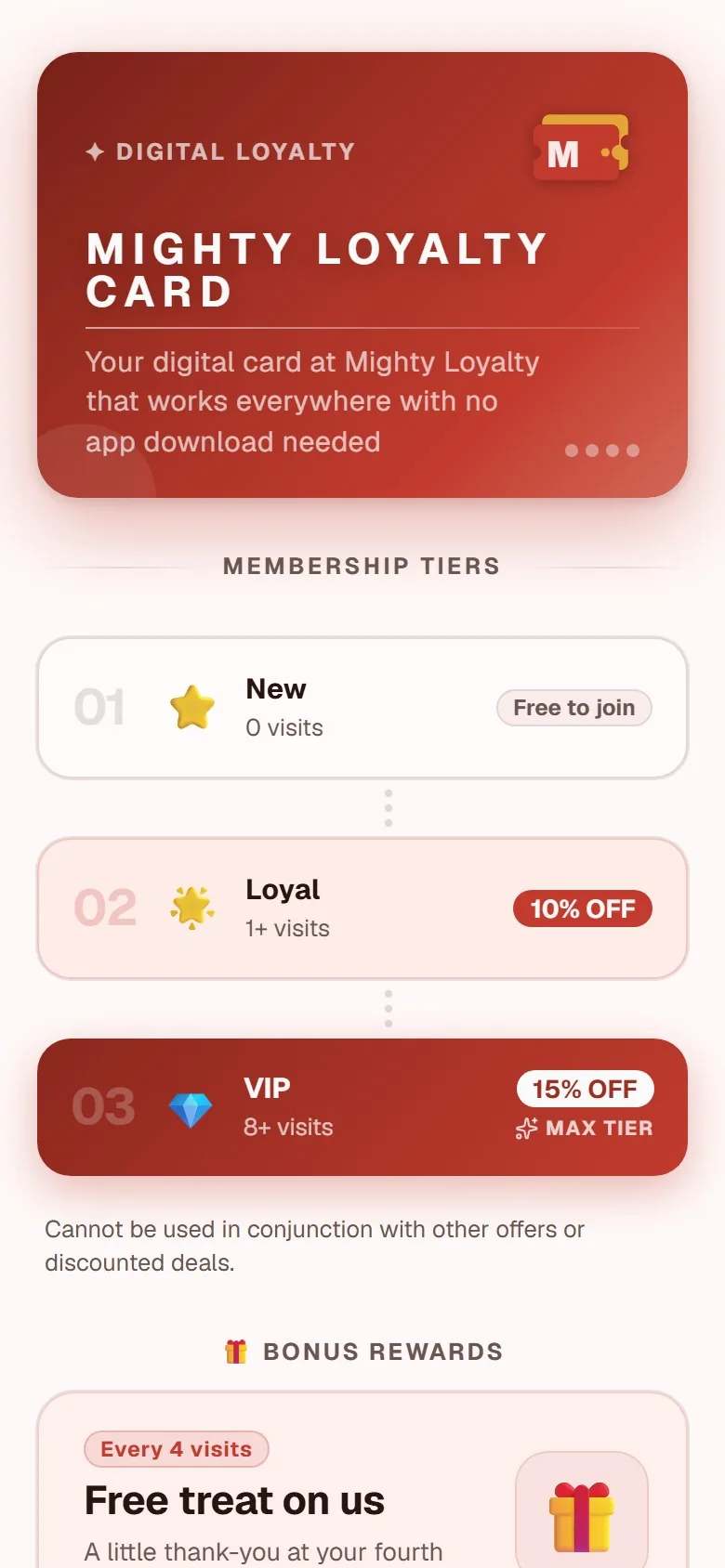
That is what a restaurant loyalty program does. The guest scans a QR code at the till, gets their card in the phone's browser without downloading an app, and leaves with a first stamp. From that moment, the guest from the Facebook group is someone you can invite back without an algorithm in between.
Three ways to build that bridge:
Mention the card at your events. A quiz night is the obvious moment: first-timers can join that evening, and the next quiz earns them another stamp.
Put it on your page. One line in the page description, or a pinned post saying regulars collect stamps, tells new visitors that coming back pays off.
Count members, not likes. Look at whether new member sign-ups rise in the weeks after an event or a post in a local group. That number tells you more than the like count. Our guide on how to get more regulars covers what to do with them next.
What you can skip
- Paid posts from day one. They can make sense later, but wait until you know which posts your own followers and neighbours respond to.
- "Like and share to win" contests. Facebook's own Pages rules ban requiring people to share a post on their own timeline or tag friends to enter. If you run a giveaway, keep it within the rules, or run it in the restaurant instead.
- The same offer every day. In a local group it quickly becomes noise, and on your own page it teaches followers to scroll past.
Frequently asked questions
Does my restaurant still need a Facebook page?
For most restaurants, yes. Many guests look you up on Facebook to find opening hours, the menu and photos, and a page is also what lets you create events and take part in local groups as a business. It just has to be kept up to date.
Can I advertise in local Facebook groups?
It depends on the group. Read the rules and ask the admin if you are unsure. Many groups welcome news that is useful to neighbours but not daily offers. The safest approach is to take part as a neighbour and let your guests recommend you.
How do I know if Facebook brings in more guests?
Ask new guests where they heard about you, and look at new members in your loyalty program in the weeks after an event or a post. If sign-ups go up, it is working. Likes and reach alone do not tell you whether anyone actually came.