Very few restaurant loyalty schemes fail because the idea was wrong. They fail on six specific, avoidable decisions, usually made in the first hour and never revisited. Here is each mistake, why it quietly drains the program, and what to do instead, whether you are starting out or reviving something that has already gone flat.
Mistake 1: Offering a percentage instead of a thing
"Ten percent off your next visit" is arithmetic. "A free starter" is a treat. Guests do not carry a discount around in their head between visits, but they do remember that there is a free dessert waiting for them at your place.
A concrete item also protects your margin better than it looks. A percentage scales with the size of the bill, so your biggest tables cost you the most to reward. A named dish costs you what it costs you, every time, and you can pick one where the gap between what it costs you and what it feels worth is widest.
Good options: a free starter, a free coffee or soft drink, a free dessert, a discounted dinner for two. Choosing between them for your specific venue is covered in the guide to rewards for loyal customers.
Mistake 2: A goal nobody can reach
A stamp goal of ten sounds fine until you remember that a restaurant guest is not a coffee drinker. Someone who eats out with you once a month needs most of a year to reach ten, and no reward stays motivating for that long.
Set the goal against your own visit rhythm, not against a number you saw on a cafe card. A guest should reach the reward within roughly three to five weeks of normal behavior for your kind of venue. Too few stamps and the reward feels automatic; too many and the program dies quietly with everyone stuck at four.
If you already launched with a goal that is too high, lower it and tell people. Members keep the stamps they have, and the guests sitting at six suddenly discover they are nearly there.
Mistake 3: Rules that need a paragraph to explain
Every exception you add makes the program harder to explain and slightly less trustworthy. Minimum spend. Not valid Fridays. Excludes the set menu. One per table. Each of these is individually reasonable and collectively fatal, because the server now needs thirty seconds and an apology to describe your loyalty card.
The test is simple: your program should be explainable in one sentence, at the table, by the newest member of staff. If it cannot be, cut conditions until it can.
The most common one worth cutting is the exclusion of your best-selling dish. If the reward cannot be the thing people actually come for, guests read the whole scheme as a trick.
Mistake 4: Starting with points and tiers
There are three real mechanics, and only one sensible starting point.
Stamps work for most venues. One visit earns one stamp; a fixed number unlocks a reward. A diner can explain it to their partner in five words, and staff can mention it at the till without breaking stride.
Points make sense when the bill swings widely, because a table ordering three courses feels poorly served by the same single stamp a solo coffee drinker gets. The trade-off is arithmetic: guests have to calculate to know how close they are.
Tiers layer on top of either one and give your most loyal guests something to aim at once the first free coffee stops being exciting.
The mistake is starting with all three. Launch with stamps and one reward, learn how your guests actually behave, and add complexity only when you can name the specific problem it solves. Six concrete ideas at that level of simplicity are in loyalty program ideas for restaurants.
Mistake 5: Nobody ever looks at the numbers
A program that nobody measures drifts, and by the time you notice, you have been giving away starters for six months without knowing whether anyone came back for them. Three numbers, checked weekly, are enough.
Return rate. Of the members active last month, how many came back this month? Rising means it is working. Flat means the reward or the goal needs adjusting.
Visits per active member. Total visits divided by active members in the same period. Rising means the program is pulling people in more often; flat means the mechanic is not motivating extra trips.
Redemption rate. What share of members actually reaches the reward? Almost nobody means the goal is too high. Everybody within a fortnight means it is too low.
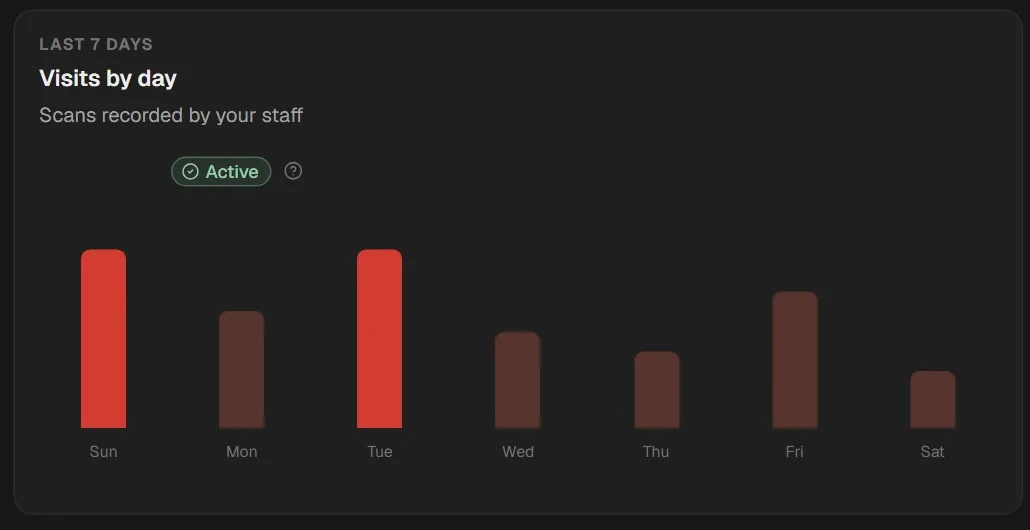
All three are visible in a digital dashboard from day one. On paper cards, count redeemed cards each week in a notebook: the rhythm matters more than the precision.
Mistake 6: Never asking your best guests for a review
This is the one owners miss most often, and it is free. A guest who has visited ten times and just redeemed a reward has three things a first-timer does not: specific experiences to describe, an attachment to your restaurant, and the sense that you value her custom.
Ask that guest for a Google review, at that moment, with a direct link. The answer is far more likely to be yes, and the review is far more likely to be detailed, which carries more weight than a bare five stars. The loop feeds itself: loyalty makes warm guests, warm guests write reviews, reviews bring new guests, new guests become members. The tactical side, including what staff should say and how to handle negative feedback, is in how to get more Google reviews for your restaurant. And to hear an unhappy guest before the review is written, see customer feedback for restaurants.
Fixing all six in one sitting
None of these take long to undo. Pick the reward, set the goal against your real visit rhythm, delete every condition you cannot say in one breath, drop back to stamps only, put the three numbers in your calendar, and start asking redeemers for reviews.
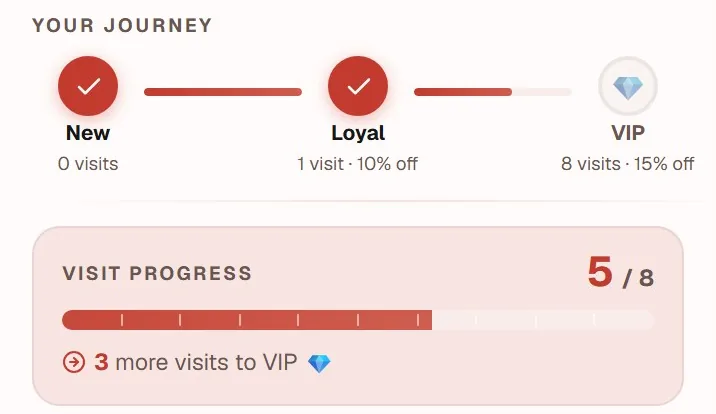
For a concrete look at what the stamp card experience looks like for a guest from the first QR scan to a completed card, see the stamp card app page. If you are rebuilding from scratch rather than repairing, the structure and running costs are laid out on our restaurant loyalty program page, including what is included at 99 DKK and 249 DKK per month, with no setup fee and no binding period.
Frequently asked questions
Can I fix a program that has already gone flat, or should I relaunch it?
Fix it first. A relaunch asks guests to care twice, and the ones who signed up and lost interest are the hardest audience you have. Change the reward or lower the goal, then tell existing members directly what changed and what it means for the stamps they already hold. A relaunch only makes sense if the original program collected so few members that there is effectively nobody to disappoint.
Will changing the reward upset members who joined for the old one?
Not if you handle the transition properly. Give notice before the change, let anyone close to the old reward claim it under the old terms, and make the new reward at least as attractive. Problems come from silent changes, not from changes as such. Guests accept that a program evolves; they do not accept discovering that the thing they were collecting towards has quietly disappeared.
How long before I know whether the program is working?
Give it eight weeks before judging it. The first two weeks tell you only whether staff are asking, which is worth knowing on its own. Repeat visits driven by the card take a month or more to appear, because a guest has to complete a full visit cycle before the effect can show up at all. What you should see immediately is member growth; what you should see by week eight is the return rate moving.