Most loyalty program ideas for restaurants fail for the same boring reason: they are too big to start. You do not need a rebrand, an app build or an agency. You need one mechanic a busy server can explain in a sentence, and a way to tell in four weeks whether it moved anything.
Below are six ideas you can put in place this week. For each one: what it is, what it actually costs you, and the number that tells you whether it worked.
1. The stamp card
What it is. The customer collects a stamp per visit and gets something free at a set number. Ten stamps for a free coffee, eight for a free starter, six for a free dessert. It is the oldest idea in the category and still the best first move, because the customer counts their own progress and your staff can explain it in five seconds. For a full overview of what a digital version includes, see the stamp card app page.
What it costs you. Not the menu price of the reward: the food cost of it. Take your own purchase price for the item you give away and multiply by the number of rewards you expect to hand out per month. Pick something with a low ingredient cost and a high perceived value and this stays cheap forever.
How you know it worked. Track the share of members who reach a second stamp within 30 days. One stamp means they signed up. Two means they came back. If a lot of cards stall at one, the problem is not the reward, it is that nobody mentions the program at the counter (see idea 6). If you are stuck on what to give away, the guide to choosing the right stamp card reward works through the trade-offs.
2. The tier ladder
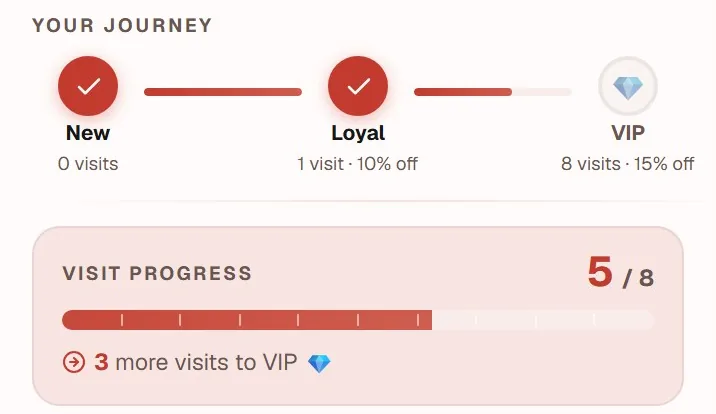
What it is. On top of the stamp card, customers move up a status ladder as they keep visiting: bronze, silver, gold. The stamp mechanic never changes; what changes is what those stamps buy at each level, plus a perk money cannot get you (early access to a tasting, a table held on a busy Friday).
What it costs you. Very little in cash, quite a lot in clarity. Your top tier should include at least one reward that costs nothing to give: recognition, priority, an invitation. Set the thresholds against your real regulars. If your most loyal current customer would not reach gold within a year at their current pace, the bar is too high.
How you know it worked. Compare visit frequency between tiers after two or three months. If silver and gold members are not visiting noticeably more often than bronze, the ladder is decoration rather than motivation, and you should simplify back to a flat card. The mechanics are laid out in the guide to loyalty tiers.
3. The quiet Tuesday offer
What it is. A reward that only exists when you are empty. Double stamps between 2pm and 5pm. A members-only lunch price on Tuesdays. A free side before 6pm on a Monday. You are not discounting your business, you are moving demand into hours you already pay rent and staff for.
What it costs you. The margin on the extra item, on covers you would not otherwise have sold. An empty table at 3pm earns nothing, so almost any margin beats it. The risk is cannibalisation, where regulars who would have come at 7pm shift to the cheap hour, so keep the window narrow and clearly stated.
How you know it worked. Count covers in the target hours for four weeks before and four weeks after. Same weekday, same season, no other changes running. If those hours go up and your peak holds steady, it worked. If peak dips by roughly what the quiet hours gained, stop it. There is a full playbook in the guide to filling quiet hours in a restaurant.
4. The birthday reward
What it is. You collect the customer's birthday month at sign-up and send one message that month with something free attached: a dessert, a glass of something, a starter for the table. It arrives when the person already wants an excuse to book somewhere, which is why it is worth the small amount of admin.
What it costs you. One item's food cost per redeeming member per year, and five minutes a month to send the message. Do not attach a minimum spend. A birthday reward with conditions reads as a coupon and gets ignored. The reward is free; the table of four who came with the birthday guest is where you make the money.
How you know it worked. Redemption rate on birthday messages, and the size of the party on those bookings. If very few people redeem, the offer is too small or the message arrived too late. Send it on the first of the month, not on the day.
5. The referral ask
What it is. An existing member brings a friend, and both get something. The friend gets their first stamp free (a head start motivates better than a discount), and the member gets a bonus stamp when the friend signs up. No codes to type, no landing page: the member shows their card and the friend scans the same QR poster.
What it costs you. Two stamps of value per successful referral, which is the cheapest customer acquisition available to a restaurant. Compare it with a month of paid social and it stops being a close contest.
How you know it worked. Count sign-ups from the referral flow per month. Even a handful is a win at this cost. Be realistic about the ceiling: referrals come in bursts, usually when a staff member is actively mentioning them. The full setup, from the reward to keeping fake sign-ups out, is in referral programs for small business.
6. The staff script
What it is. Not a program at all, but the reason the other five either work or die. One sentence, agreed with the team, said at the same moment in every transaction: "We have a digital stamp card if you want to collect towards a free dessert, it takes one scan." No pitch, no explanation of tiers, no leaflet.
What it costs you. Nothing but the fifteen minutes it takes to agree the wording and put it on the wall behind the counter. This is the highest return idea on this list, and the one owners consistently skip.
How you know it worked. Sign-ups per hundred transactions, compared week to week. If that number differs sharply between shifts, you do not have a program problem, you have a shift that is not saying the sentence. Fix it with a two minute pre-shift reminder rather than a bigger reward. There is more on this in the guide to training staff on your loyalty program.
Picking the one to start with
If you sell something people buy weekly (coffee, lunch, takeaway), start with the stamp card and the staff script together, and nothing else. If your customers come monthly and spend a lot when they do, start with the birthday reward and the quiet hours offer, because a stamp goal they cannot reach in two months will not motivate anyone.
Running these digitally costs less than most owners expect. MightyLoyalty starts at 99 DKK per month for the stamp card, the QR poster and the owner dashboard; details are on the pricing page, and there is a worked setup on the restaurant loyalty program page. You can also see a live program from the customer's side at our own restaurant: https://loyalty.maiya.dk/
Frequently asked questions
How many of these ideas should a restaurant run at once?
One to start, two or three at most once they are habits. Every idea here adds a sentence your staff have to remember at the till, and the constraint is attention, not budget. A stamp card everybody mentions beats four clever mechanics nobody explains. Add the next idea only when the current one runs for a full month without you prompting anyone.
Do loyalty rewards have to be free food?
No. Free food is simply the easiest reward to value and hand over. Access works just as well for many guests: first pick of a limited dish, a table held during a busy service, an invitation to a tasting evening, or skipping the queue at lunch. These cost you almost nothing and they are harder for a competitor down the street to copy than a free coffee.
How long before I can tell whether a loyalty program is working?
Give it four weeks for sign-up numbers and about three months for repeat visit behaviour. Sign-ups tell you whether staff are mentioning it, which you can fix immediately. Return frequency needs enough visits per member to show a pattern, so judging the whole program after two weeks tells you almost nothing.