Member-only offers are deals that only guests in your loyalty program can use, while a public promotion is open to anyone who walks in. Both can fill a slow Tuesday, but they reach different guests and leave you with a different bill afterwards. Here is how they differ, and how to decide who should get the discount.
The public promotion: good for reaching new people
The public promotion is the familiar one: a pavement sign saying "2 for 1 on coffee today", a lunch deal posted on Facebook, an offer in the local paper. Its strength is real. It speaks to people who do not know you yet, and it asks nothing of them. No sign-up, nothing to show, nothing to remember.
That is also why it costs more than it looks:
- Your regulars get it too. The guest who comes every Tuesday anyway now gets the same discount as the newcomer. That share of the discount buys no extra visits.
- You learn nothing. At the end of the day you know it was busy. You do not know who came for the deal, or whether any of them came back.
- It resets the price. Run the same deal long enough and it stops being a deal. Guests wait for it, and the normal price starts to feel like a surcharge.
None of this makes public promotions wrong. It makes them a tool for winning new guests, and a poor tool for rewarding the ones you already have.
The member-only offer: a discount for someone you know
A member-only offer flips that. The discount goes only to guests in your program, and you can narrow it further: only members on a certain tier, only on a first visit, or only guests who have been in a set number of times.
That gives you three things a public promotion cannot:
- You decide who pays. The discount lands with the guests you want to move, not with everyone who happens to pass.
- You can measure it. Because the offer is tied to a membership, you can see afterwards who used it and whether they came back.
- It feels like recognition. "Members only" tells a regular you have noticed them. A public deal tells them everyone else gets the same.
There is a catch. A member-only offer cannot reach people who are not members yet. If you have almost no members, you have almost nobody to give it to. So the question is not either or; it is which job the offer has to do.
Side by side
Here is the difference in one place. The left column is the question worth asking before you create any offer.
Question | Public | Members |
|---|---|---|
| Who can use it? | Everyone | Members, or a subset |
| Does it reach new guests? | Yes | Only through sign-up |
| Do regulars get it anyway? | Yes | Only if you choose |
| Can you see who used it? | No | Yes |
| Can you cap it per guest? | Only through staff | Yes, in the system |
Who actually pays for the discount?
The clearest way to see the difference is to think about the guests who would have come anyway. Picture a café that takes 20 percent off lunch every Tuesday, where half of Tuesday's lunch guests are regulars who come regardless. With a public promotion, half of the total discount goes to guests who changed nothing. That half is pure cost.
A member-only offer lets you narrow it. Give the Tuesday discount only to members who have not been in for a month, say, or only on a first visit. Then the discount goes to the guests you are actually trying to move. The numbers in that example are made up, but the arithmetic holds for any business: the more of the people getting a discount would have come anyway, the more each extra visit costs you.
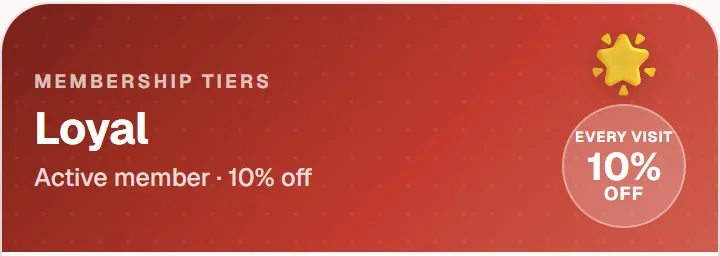
This is also why a standing discount on a tier works differently from a campaign. A regular on your top tier has earned that discount by coming back again and again. How to set those levels is covered in loyalty tiers.
Setting up a member-only offer
In MightyLoyalty you create offers in the owner portal. For each one you choose what the guest gets (percent off, buy one get one, a free item or bonus stamps, for example) and who may use it:
- All members or specific tiers. An offer can apply to everyone in the program or only to members on a particular tier.
- First visit only. A natural welcome for new members.
- A minimum number of visits or stamps. So the offer only unlocks once a guest has been in a few times.
- Time windows. Specific weekdays and hours, so the offer hits the hours that need it.
- Caps. A total limit on redemptions and a limit per guest per day, week or month.
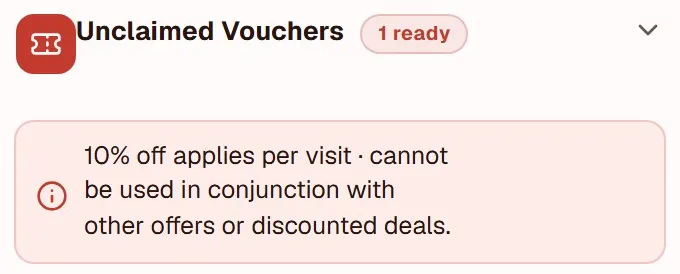
At the counter, staff scan the guest's card and see the offers that guest can use right now. The rules are checked by the system, so nobody has to remember who is allowed what. Afterwards the portal shows how often the offer was used and what it cost you in discounts. The difference between an offer on paper and one on the card is covered in digital coupons vs paper coupons.
Offers are part of Standard. Telling members about an offer by push message or email is an add-on on Standard and included in Pro.
When a public promotion is still the right call
Sometimes you need to talk to everyone:
- You have just opened. With no members there is nobody to give a member-only offer to. A public deal is what brings in the first guests.
- You want to reach a new area. A flyer in a new street reaches people who have never heard of you.
- You need to fill one specific day fast. When the goal is a full room for an event and it matters less who comes.
Even then, let the public promotion point towards signing up. The strongest combination is often a public deal that gets people through the door, plus a first-visit member offer that gives them a reason to join. The new guest you paid to bring in becomes a guest you can talk to again. More ideas for filling slow hours are in quiet hours at your restaurant, and the program that carries all of this is described on the free loyalty program page.
A simple rule of thumb
Use public promotions to bring new people in. Use member-only offers to bring them back. The more a discount goes to people who would have come anyway, the more it should be a member-only offer with a narrow audience.
Frequently asked questions
Does "members only" put new guests off?
Not if joining is easy. Guests scan a QR code and are members straight away, with no app to download. Say on the sign how to join, so the offer reads as an invitation rather than a closed door.
Can I give different offers to different tiers?
Yes. An offer can be limited to specific tiers, so your most loyal guests get something new members do not. That makes the tiers more worth reaching.
How many member-only offers should I run at once?
Few. One or two offers, each with a clear purpose, are easier for staff to explain and easier for you to measure than a long list. After a few weeks, check whether the offer changed anything, and stop it if it did not.