Customer feedback in a restaurant is what guests tell you directly about their visit, usually a rating and a short comment, before they tell anyone else. It is worth most when something went wrong, because it gives you a chance to put it right while the guest is still yours. Here is how to ask for it, and what to do when it is bad.
Why unhappy guests rarely say anything
Ask a guest at the till whether everything was alright and the answer is almost always yes. Not because it was, but because complaining face to face is awkward, especially to the person who just brought the food. Plenty of people would rather pay, say thanks and simply not come back.
That quiet group costs you the most. A guest who complains loudly at least gives you a chance to help. A guest who leaves quietly only shows up later: as a regular you stop seeing, or as a review you can no longer do anything about.
Collecting customer feedback is about giving that quiet group an easy, private way to say it. Not to hide criticism, but to hear it while you can still act.
Ask briefly, and ask close to the visit
The best feedback form is the one guests actually fill in. That comes down to three things.
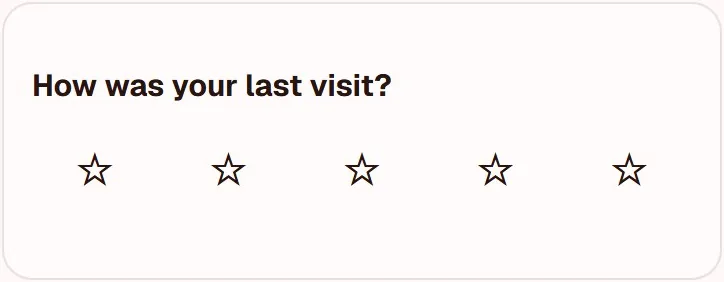
One question first. "How was your visit?" with five stars is enough to start. A long survey about food, service, waiting time and music gets closed by most people, and the ones who finish it are not the ones you most need to hear from.
A comment only when it helps. If the rating is low, ask what you could have done better and make the field optional. A five-star guest does not need to explain themselves.
Close to the visit. A rating the same day or the day after is about what actually happened. Ask a month later and you get a general impression; the detail about the cold pasta is gone.
Ask your staff to mention it too when they can tell something went wrong: "If anything was off, we would really like to hear it, you can also write to us afterwards." It costs nothing and tells the guest criticism is welcome. How to bring staff along without a long briefing is covered in staff loyalty program training.
What to do with a bad rating
A bad rating is not the problem. A bad rating nobody reads is. Set a fixed rhythm so every one gets read and answered.
Check feedback daily, or at least a few times a week.
Thank them for being honest and say exactly what you heard.
Talk to the kitchen or the team about the specific thing.
A short note on what changed, and an invitation back.
The reply is the step that matters most. Do not apologise in a way that sounds like a template, and do not explain why the guest is wrong. Write the way you would talk: "Thanks for telling us. The wait on Friday does not sound good, and we have talked it through in the kitchen. Do come back, we would like to show you we can do better."
Whether to add something to the reply is a judgement call. A small gesture can be fine, but it must not become a fixed price for complaining. What matters is that the guest can tell someone actually read it.
Do not turn feedback into a wall
This is where it is easy to overdo it. The point of private feedback is to hear criticism first, not to stop it going public. A guest who had a bad evening is entitled to write a review, and you should not try to prevent that.
So steer clear of three things:
- No rewards for good reviews. Never give stamps, discounts or gifts for a review with lots of stars. It is not honest towards the people reading the reviews.
- No pressure. Ask once and leave it there. A guest who says no should not be asked again on the next visit.
- No deals. Do not promise to "make it right" if the guest removes a review. Fix the problem because it is a problem.
Private feedback does something different and better: it lets you solve the problem before the guest walks away with an experience nobody fixed. How to answer the reviews that do arrive, and how to get more of them from happy guests, is in how to get more Google reviews for your restaurant.
How it works in MightyLoyalty
Guest feedback is an add-on from 19 DKK a month on Standard and included in Pro. Once it is switched on, members see a short question in their web app about how their last visit was, with five stars. It is one tap, with no app to download.
What happens next depends on the rating:
Rating | The guest sees | You |
|---|---|---|
| 4 to 5 stars | A link to your Google profile, if you have added it | Say thanks, and see who was sent on |
| 1 to 3 stars | An optional box: what could we do better? | Read the comment and follow up personally |
In your owner portal, the Feedback page pulls it together: the average, how many guests gave 4 or 5 stars, how many gave 1 to 3 and need attention, and the list of ratings with the member's name, any comment and the date. Ratings where the guest was sent on to Google are tagged, so you can see where your reviews come from.
The question does not pop up every time the guest opens the app. Once they have answered or dismissed it, it waits 14 days before showing again, so it feels like a question rather than a nag.
Look for patterns, not culprits
One bad rating tells you about one evening. Ten tell you something about your restaurant. Read them together once a month and ask: do several guests mention the same thing? Is it the same days or times? Is it something new?
Use feedback to find what needs fixing, not to find which staff member to blame. Once feedback becomes a way to single people out, your team stops asking guests for it.
Feedback also belongs with the rest of your guest data. A guest who gave two stars and then stopped coming is an obvious person to reach out to. How to read the data you already have is in guest data for restaurant marketing, and how to approach guests who have drifted away is in how to win back lapsed customers. For building a steady base of regulars in a restaurant, see the page on restaurant loyalty programs.
Frequently asked questions
How do I get restaurant guests to give feedback?
Keep it short and close to the visit: one five-star question the same day or the day after. Only ask for a comment when the rating is low, and make it optional.
How should I reply to negative customer feedback?
Thank the guest for being honest, say specifically what you heard, and explain what you are doing about it. Skip template replies and explanations of why the guest is wrong, and invite them back.
Can I ask only happy guests for a Google review?
You can ask guests for a review, but never reward good reviews or try to stop unhappy guests from writing one. Private feedback is there to help you fix mistakes, not to hide them.