Customer retention is the share of your customers from one period who also buy from you in the next. For a small business it is a number you can measure, not a vague sense that "people seem to come back". This guide shows how to work it out from your own visits, which period to measure over, and which levers actually move it.
A number, not a feeling
Retention and loyalty get used as if they meant the same thing. They do not. Loyalty is the customer's relationship with you: they prefer your café over the one on the corner. Retention is what you can count: how many of the people who were in last time came in again this time. For the relationship side, and the three mechanics a loyalty program can be built on, start with the guide to customer loyalty for small business.
The difference matters because a number can be tracked. You can see whether it rises after a change, and you can catch it early when it starts to slip. A feeling you can only argue about.
How to calculate your retention rate
The simplest method needs just two lists: the customers who were active in one period, and the customers who were active in the next.
- Pick a starting period, for example September.
- Count how many different customers came in during that period.
- Count how many of those same customers also came in during the next period, for example October.
- Divide the second number by the first.
New customers who came in for the first time in October stay out of the calculation. They are good news, but they tell you about attracting people, not keeping them. Mix the two together and a strong month full of new faces can hide the fact that your old regulars are drifting away.
Picture a café where 200 members came in during September, and 120 of them came back in October. Retention for that month is 120 divided by 200, or 60 percent. On its own that number is neither good nor bad. It only becomes useful when you compare it with next month, and with the same month last year.
Match the period to your business
The most common mistake is measuring over a period that does not fit how often your customers naturally visit. Measure a hair salon week by week and it looks as if almost nobody comes back, because nobody gets a haircut every week. Measure a coffee bar by the quarter and everything looks fine, even if the morning crowd has gone from five visits a week to one.
The rule of thumb: make the period a little longer than the usual gap between two visits from a regular. A café with daily guests can measure monthly. A salon whose clients come every other month should measure quarterly. Pick one period and stick with it so the numbers stay comparable.
Count visits, not stamps
Retention is about the customer coming back, so count visits, not stamps. For a café that gives one stamp per visit, those are the same number. But if you stamp per item or per amount spent, one big visit can earn many stamps, and that does not make the customer any more retained than someone who comes in every week and buys a little.
The same goes for judging whether your program works. A high number of stamps handed out can hide the fact that only a few customers are earning them.
Where do you lose customers?
Once you have the number, the next question is where customers drop off. For most small businesses there are three places worth looking:
Between the first and second visit. Someone who has been in once has no habit yet. If they do not return within the first period, many of them never will.
Right after the reward. When the card is full and the reward claimed, a pause is natural. If the new card is not visible straight away, the pause easily becomes permanent.
In the quiet months. January, the summer holidays, or your own season's low point. Visits drop for everyone, and the question is whether your regulars come back afterwards.
Five levers that improve retention
There is no single fix, but these five levers target the three drop-off points above.
- Make the second visit a goal in itself. A small reward early on the card, say at the third stamp, gives people a reason to come back soon, long before the card is full.
- Set a stamp target people can reach. Few customers stay motivated by a goal that takes six months. Work backwards from how often your typical regular visits.
- Show the new card immediately. With a digital stamp card, the next card starts automatically once the reward is claimed, so the customer sees they are already on their way again.
- Reach out before they are gone. A friendly message to members who have not been in for a while works better than a campaign to everyone. The playbook is in how to win back lapsed customers.
- Let staff recognise regulars. When staff scan the card and see the customer's name and tier, "good to see you again" comes naturally. More counter tactics are in how to get more regulars.
A small reward early on the card
Work back from how often a regular visits
So the pause after a reward stays short
A message to members who have not been in
Name and tier on screen when staff scan
What the dashboard shows you
With paper cards you cannot calculate retention, because you do not know who held the card. With a digital card every visit is recorded against a member, so the numbers are simply there.
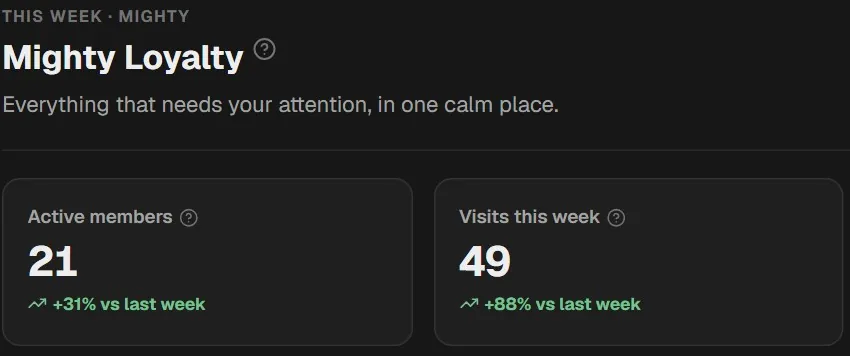
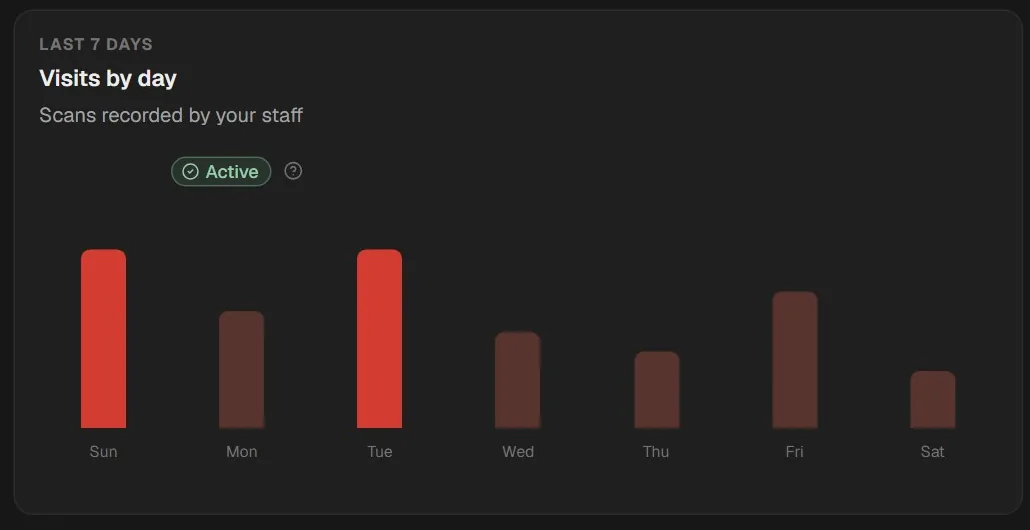
In MightyLoyalty the owner dashboard shows active members and visits this week against last week, alongside new members and rewards redeemed. That is enough to see the direction. To go deeper, the advanced analytics add-on adds churn and cohorts, so you can follow each month's new members over time. Automatic win-back emails, sent to members who have not been in for a number of days you choose, come with the automations add-on. Each add-on costs from 19 DKK a month on Standard and both are included in Pro. How it all fits together as a loyalty program is on the free loyalty program page.
Standard costs 99 DKK a month and Pro 249 DKK a month, both excl. VAT. You can try every Pro feature for 14 days with no payment card, no setup fee and no binding period. To turn your retention numbers into money afterwards, measuring loyalty program ROI shows how.
Frequently asked questions
What is a good customer retention rate for a café or restaurant?
There is no single number that fits everyone, and we will not make one up. It depends on how often your customers naturally visit, where you are, and the period you measure over. What matters is your own trend: if the number climbs month on month, you are doing something right.
How often should I measure customer retention?
Once per period, using the same period every time. For a café that usually means once a month. Measure more often than customers naturally visit and you mostly get noise.
Can I measure retention without a loyalty program?
Only roughly. Your till can show how many sales you made, but rarely who made them, unless a customer pays with the same card every time. A loyalty program that ties every visit to a member is the easiest way to get a number you can trust.