Stamp expiry means that stamps or rewards a guest has earned disappear after a set period if they go unused. Whether your loyalty stamps should expire sounds like a technical setting, but it is really a question about trust. Here are the arguments on both sides, the three models you can choose from, and how to introduce a rule without letting your regulars down.
Why expiry is a question at all
Paper stamp cards solved the problem on their own. The card got crumpled, went through the wash or stayed in last winter's coat, and the stamps were gone. Nobody thought of that as a policy, but in practice a lot of paper cards expired.
A digital stamp card never loses anything by accident. A stamp from last winter is still there when the guest comes back a year later. That is good for the guest, but it leaves you with a question as the owner: are you happy to honour a reward that was earned long ago, perhaps at a price or on a menu you no longer have?
The case for an expiry date
A reward should be used while it still matters. A stamp card works because it gives the guest a reason to come back soon. A reward with no time limit has no reason to be collected this month rather than in six months.
You can change your programme without old baggage. If you swap the reward, the range or the price, it is easier when old stamps are not hanging around for years.
Your numbers stay honest. If you estimate how many rewards could still be claimed, old dormant cards give you a distorted view of what you owe.
The case against
It feels like taking something away. The stamps were earned with real visits. When they vanish, the guest does not see a policy, they see a loss, and that is rarely the feeling you want a regular to walk away from the counter with.
It hits the wrong people. The guest who has been away for six months because of a new baby, a move or a busy job is exactly the one you want back. An expired card gives them one less reason to return.
Someone has to explain it. Every time a guest is surprised by an expiry, your staff have to have that conversation. It takes time and costs goodwill.
Three models to choose from
Most small businesses end up with one of three models. The right one depends on how often your guests come in and how much a reward costs you.
Model | The guest experiences | Suits |
|---|---|---|
| No expiry | Their stamps are always safe | Most cafes, bakeries and salons |
| Expiry after long inactivity | The card resets only if they are truly gone | Businesses that change programmes often |
| Expiry on earned rewards | The reward must be collected by a deadline | Costly rewards and campaigns |
No expiry is the simplest and friendliest model. It fits when the reward is cheap for you to give, a coffee or a pastry, and when most guests fill the card within a couple of months anyway.
Expiry after long inactivity means stamps only disappear if the guest has not been in at all for a long stretch, say a year. Someone who comes now and then never loses anything. It clears out forgotten cards without punishing the guests who actually show up.
Expiry on earned rewards leaves the stamps alone but sets a deadline once the card is full: "Your free lunch is waiting for the next three months." A deadline at that point often reads as a friendly nudge, because the guest has something concrete to come in for.
Fair rules if you do choose expiry
If you go with an expiry rule, the way you introduce it decides whether guests accept it.
One sentence in your terms that a guest understands without asking
Stamps earned before the change keep the old rules
Tell members about the change before it takes effect
Send word before a reward expires, not after
Make the rule plain. An expiry rule the guest did not know about feels like a trap. It belongs in your terms, in one sentence without legal detours. Danish marketing rules expect the conditions of offers and perks to be clear and easy to find. This is not legal advice, so check with an adviser if you are unsure, and read the loyalty data and GDPR guide if you are tidying up old member data at the same time.
Apply it going forward. If you add expiry to a programme that is already running, let stamps earned before the change keep the old rules. Wiping guests' stamps retroactively is the fastest route to a bad review.
Give notice and remind. Tell members about the change before it applies, and let them know before a reward runs out. A reminder that "your free coffee is waiting" is a good reason to drop by in its own right.
Be generous at the edges. If a guest turns up three days after the deadline, give them the reward anyway. The rule exists to clear out forgotten cards, not to win an argument with a regular.
An alternative to expiry: bring the guest back
Often the real problem is not the old stamps but that the guest has stopped coming. Instead of letting the card expire, use the half-full card as a reason to reach out. A guest who is two stamps short of a reward has a concrete reason to come back, and that reason disappears if the stamps do. The guide to winning back lapsed customers shows how to go about it.
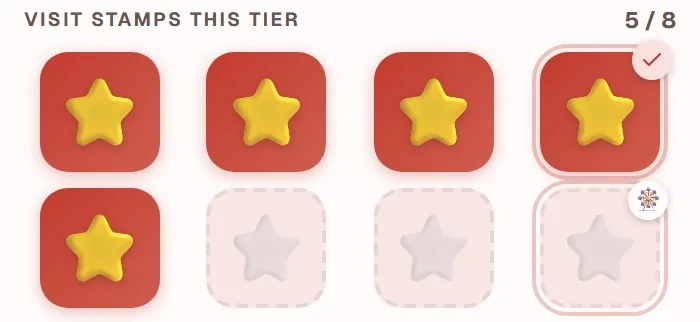
When guests can see their own stamps on their phone, there is no argument about what is on the card either. That removes much of the reason for expiry, which on paper was often about avoiding disputes over worn or forged cards. What else keeps a digital card honest is covered in loyalty program fraud prevention.
How it works in MightyLoyalty
In MightyLoyalty, earned stamps do not expire on their own. A guest's stamps stay on the card until they are spent on a reward. Time-limited offers, on the other hand, can be given an end date, so a campaign stops by itself when its period is over. If you want an expiry rule for your stamp card, it is something you describe in your terms and apply at the counter, not something the system does for you.
How the stamp card itself is set up, with its goal, rewards and your own branding, is shown on the stamp card app page.
Frequently asked questions
Am I allowed to let stamps expire?
Yes, you set the rules for your own loyalty programme. What matters is that the rule is clearly written in your terms, that guests know it before they start collecting, and that you never change it retroactively.
How long should stamps last before they expire?
There is no single right answer, but the window should be long enough that a guest who visits regularly never hits it. That is why many owners tie expiry to long inactivity rather than to the date of each stamp.
Is it better to expire the reward than the stamps?
Often, yes. A deadline on an earned reward works as a reminder to come in, while expiring half-full cards mostly feels like a loss to the guest.