A digital loyalty card is one of the most practical tools a restaurant, café, or salon can add in 2026, yet many owners either stick with paper punch cards or assume loyalty has to come built into their point-of-sale system. This guide explains what a digital loyalty card actually is, what a good one should include, and what to look for before you commit.
What is a digital loyalty card?
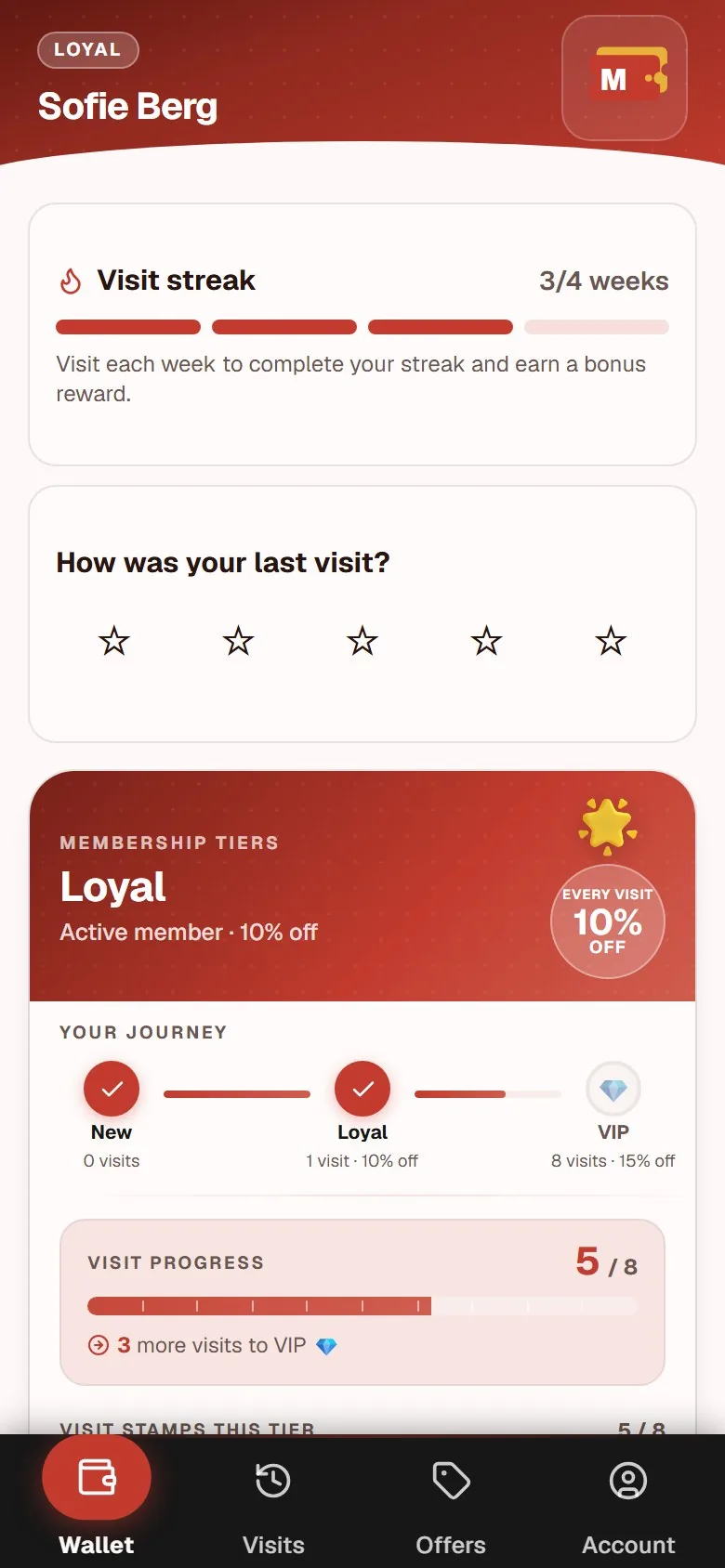
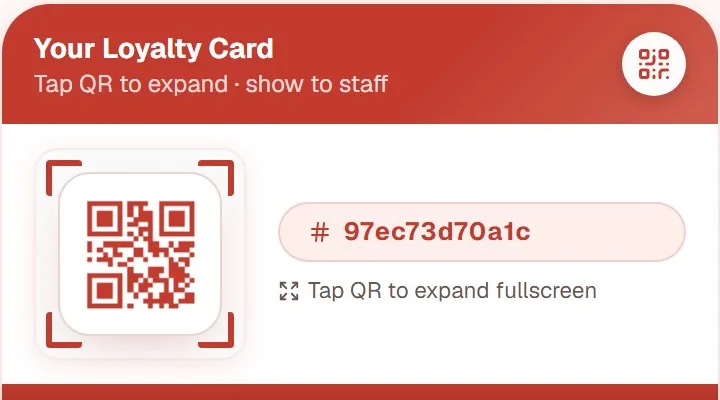
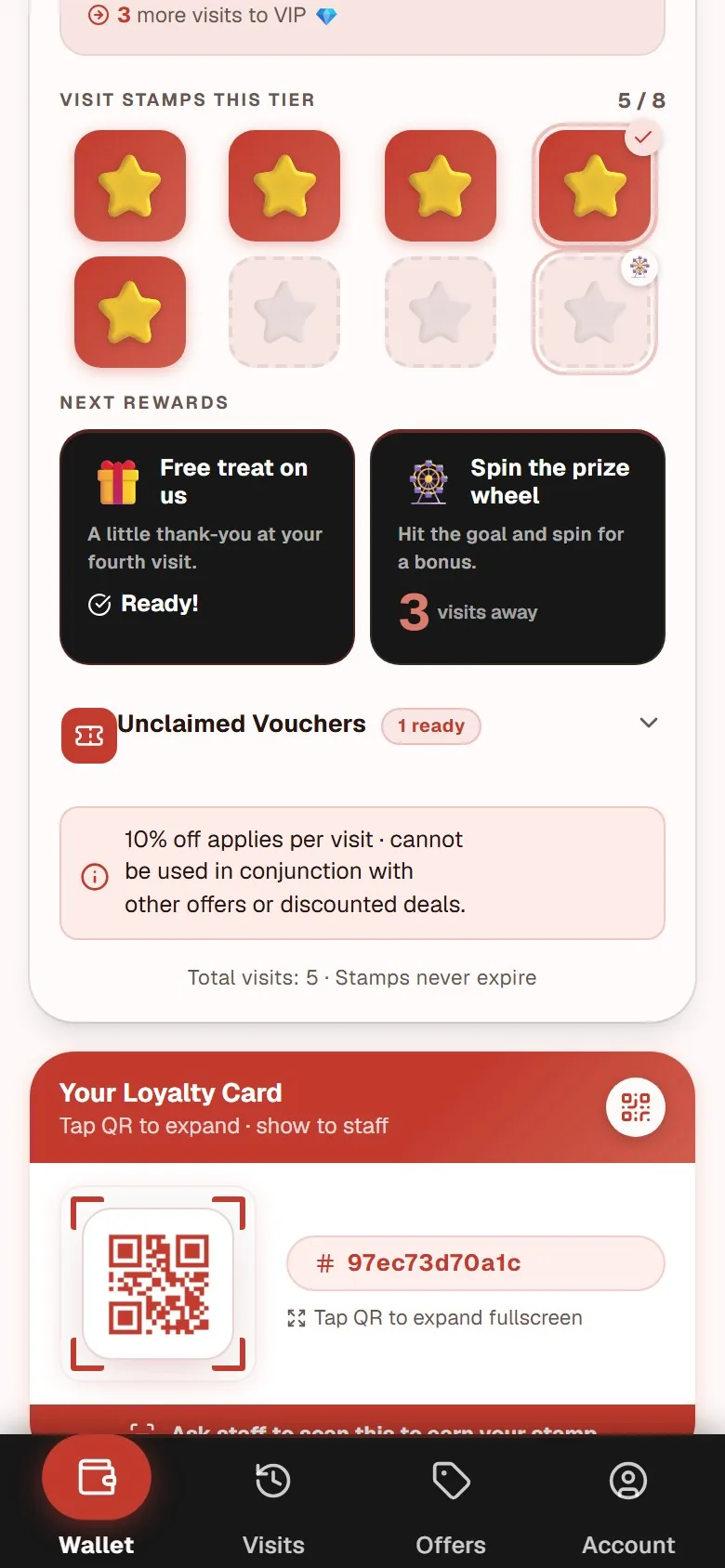
A digital loyalty card is a web-based alternative to the paper punch card. Customers access it through their smartphone browser: no app download, no account in an app store. They receive a personal QR code when they sign up, and a staff member scans that code during each visit to award a stamp. Once the customer reaches the target number of stamps, they redeem their reward.
The practical difference from paper is not just the material. It is ownership and data.
With a paper card, you know a card was filled because you hold it in your hand. You have no record of how many customers stopped coming after three stamps, how many filled cards were never redeemed, or which hour of the day drives your most loyal visits. A digital card stores every stamp with a timestamp and links it to an email address. That data shows you who is close to a reward, who has gone quiet, and what patterns define your most loyal customers.
You can see what this looks like from the customer's side at the live demo: https://loyalty.maiya.dk/
What makes a good digital loyalty card?
Not all digital loyalty cards are equal. Here are the four things worth evaluating before you sign up.
No app download for customers. If customers have to install an app to join, a significant share will not bother. The friction alone costs you sign-ups. A web-based card that opens directly in the mobile browser removes that barrier entirely. The customer scans your QR code, the card loads, and they are already enrolled.
Simple stamping for staff. If the stamping process requires more than a few seconds at the counter, it will slow you down during a busy lunch rush. The best systems reduce stamping to one action: open the scanner on a phone, point it at the customer's QR code. No integration with the till, no extra screen to navigate.
A customer-facing progress view. Customers who can see their current stamp count ("three of ten") are more motivated than customers who trust that their stamps are being counted somewhere they cannot see. A visible progress card drives return visits far more effectively than an opaque points balance.
An owner analytics dashboard. Stamp data is only useful if you can read and act on it. Look for a dashboard that shows visits over time, rewards redeemed, and how active your member base is. This is the tool that turns loyalty from a nice gesture into a measurable driver of repeat business.
Does your digital loyalty card need to connect to your POS?
Many point-of-sale systems now offer a built-in loyalty module, either included in the package or as a paid add-on. The argument is appealing: one system, one subscription, one dashboard. But POS-integrated loyalty carries a structural limitation that matters for most restaurants: it only records purchases made directly through the till.
If a customer orders through a delivery platform, they receive no stamp, because the transaction never passes through your POS. For restaurants that do any meaningful volume through Wolt, Just Eat, or similar services, this gap means a portion of loyal customers are being missed every day.
A standalone digital loyalty card sidesteps this entirely. The customer has their own QR code, and staff scan it regardless of how the order was placed. Stamping is fully decoupled from the POS. There is a second advantage: if you ever change your POS system, your loyalty program, your member list, and your stamp history are completely unaffected.
For a detailed side-by-side breakdown, see the comparison of POS-integrated and standalone loyalty. For businesses with straightforward in-store sales and no third-party delivery, built-in POS loyalty can be a reasonable starting point. For most cafés and restaurants in practice, standalone is the more durable choice.
What does a digital loyalty card cost?
Pricing varies depending on whether loyalty is bundled into a POS system or purchased as a standalone product.
POS-integrated loyalty modules are rarely priced transparently. They are bundled into tiered packages or sold as add-ons, with prices that depend on your contract and transaction volume. Comparison between providers is difficult because loyalty is mixed in with payment processing and other POS features.
Standalone digital loyalty cards tend to be priced as a flat monthly subscription. MightyLoyalty, for example, starts at 99 DKK per month on the Standard plan, which covers unlimited stamping, a QR poster for your counter, and the owner dashboard. The Pro plan at 249 DKK per month adds email marketing and automations. There is no binding period and no setup fee, and you cancel in the portal.
For the full feature list and to see the card in action, visit the stamp card app page.
For a full pricing breakdown across the different types of digital loyalty cards on the market, see the digital stamp card pricing guide.
What to look for when you compare options
Before you commit to a digital loyalty card, work through four questions.
Does the customer need to download anything? If yes, expect lower sign-up rates. A web-based card that opens in the browser converts better at the point of sign-up.
How does stamping work for staff? The simplest flow is a scan-and-done action that takes under ten seconds. If the demo requires more steps than that, it will cause friction at the counter.
What happens if you change your POS? A loyalty program whose data lives inside a POS platform is at risk every time you consider switching providers. A standalone card gives you full ownership of your member list and history, regardless of what happens with your till.
What is the total cost over twelve months? Include any set-up fees, per-transaction charges, and the cost of customer support. A low headline subscription can become expensive if add-ons are priced separately.
For a broader look at the options available in different categories, the overview of loyalty solutions covers the main types and what they include.
Getting the most from your digital loyalty card
A digital loyalty card works best when staff mention it actively. Customers who receive a verbal invitation at the counter sign up at a much higher rate than those who discover the QR code on their own. The script can be one sentence: "We have a digital stamp card if you want to collect towards a free coffee." That is all it takes.
The second lever is placement. A QR code at eye level at the counter, on a table card if you have seated service, and near the door gives customers three natural moments to join. A detailed guide to QR placement and what works in practice is in the digital stamp card overview. For a companion look at how a digital loyalty card compares to its physical predecessor and what the card format means in practice, see customer loyalty card: digital vs physical.
Frequently asked questions
Does a digital loyalty card work alongside any POS system?
Yes. A standalone digital loyalty card requires no technical integration with your POS system. Staff use a scan app on a phone next to the till, independently of the checkout software. You can switch POS providers, add till devices, or change payment processors without affecting the loyalty program at all.
What happens to my customer data if I change POS systems?
With a standalone digital loyalty card, nothing happens to your data. Your members keep their cards, and you keep your full membership list and stamp history. With a POS-integrated loyalty module, the answer depends on whether both your old and new provider support a compatible data export and import. In many cases owners lose their member history entirely when switching providers.
How do customers access their digital loyalty card between visits?
After their first scan, customers can save the loyalty card as a shortcut on their home screen, so it functions just like a native app without the download. The next time they visit, they open the shortcut, show the QR code, and get stamped. There is no login required at the counter and no delay in the queue.